Precious Metals
How Gold Is Used in Technology, From AI Chips to Satellites
ELECTRONICS TOOK 84% OF THE 324 TONNES OF GOLD USED IN TECHNOLOGY IN 2025
The following content is sponsored by Galiano Gold
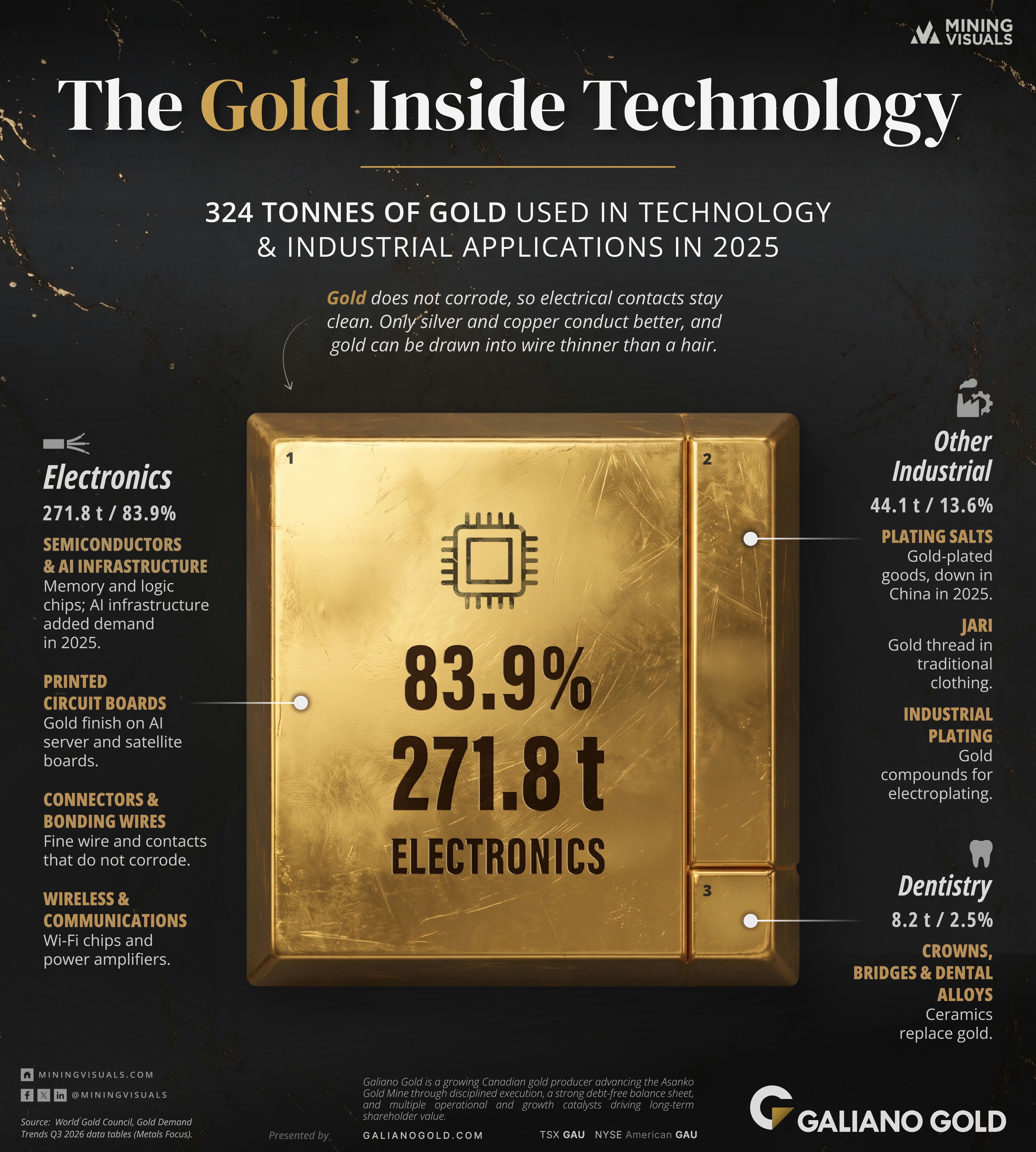

Electronics Lead: Electronics took 271.8 tonnes, or 84%, of the 324 tonnes of gold used in technology in 2025, per World Gold Council data tables.
Chosen for Reliability: In high-end and safety-critical devices, manufacturers seek the most reliable materials, and “this almost always involves gold,” the council says.
AI Hardware Adds Demand: Electronics used 72.5 tonnes of gold in Q3 2026, the most in a quarter since Q4 2017, led by memory chips and AI servers.
Micron, the US memory chipmaker, reported revenue of $133.19 billion for the year to September 3, 2026, more than three times the $37.38 billion of a year earlier. On October 15, Taiwan's TSMC, the largest contract chipmaker, reported a record third-quarter net income of NT$763.06 billion. The World Gold Council cites both in its third-quarter technology review as context for gold demand from chipmaking, because the memory chips and AI processors behind those results contain gold.
In 2025, technology used 324 tonnes of gold, according to the World Gold Council's Q3 2026 data tables. At 2025's average price of $3,432 an ounce, that was worth about $35.8 billion. Most of it sits in parts that are never seen: the contacts, boards and wires that carry signals inside phones, servers and satellites.
Gold is “an excellent conductor of electricity and highly resistant to corrosion and oxidation,” the council wrote in September. Copper and silver conduct better, but both corrode and tarnish. A gold-plated contact keeps a clean, reliable connection for the life of a device.
It does not corrode. Corrosion is a chemical reaction. Iron rusts, copper oxidises and silver tarnishes as their surfaces bond with oxygen or sulphur from the air. Gold is “the least reactive metal towards atoms or molecules at the interface with a gas or a liquid,” physicists Bjørk Hammer and Jens Nørskov wrote in Nature in 1995. Their calculations showed why: when a molecule meets a gold surface, the same electrons that could form a bond also fill states that work against it, so the bond is too weak to hold.
Gold's heavy nucleus adds a twist. With 79 protons pulling on them, some of its electrons move at more than half the speed of light, fast enough for Einstein's relativity to change how the atom behaves. Relativity is also why gold looks yellow while silver is colourless, even though silver sits directly above gold in the periodic table: gold absorbs blue light.
It is soft. Gold's softness comes from how its atoms are packed. In gold's crystal structure, “each atom is surrounded by 12 neighboring atoms,” Dror Fixler of Bar-Ilan University told Live Science, and the shared cloud of electrons that holds them together lets layers of atoms slide past one another without the metal breaking. Copper and silver have the same structure, but their crystal grains tend to be separated by thin oxide layers that make them more likely to fracture. Gold's grains are not, chemist Mark Jones explained in the same article.
The result is a metal that can be beaten into leaf about five-millionths of an inch thick, some 400 times thinner than a human hair, and one ounce can be drawn into a wire 80 kilometres long, according to Geoscience Australia. For electronics, that means a little gold goes a long way: a plating layer or a bonding wire needs only a tiny amount of metal.
It is worth the price. Because gold does not corrode or wear out quickly, it suits wiring that is hard to repair, Geoscience Australia notes. Reliability is why gold is chosen where failure is costly. In car electronics, safety and reliability requirements “tend to outweigh material cost considerations,” the council says, so gold is the preferred metal for bonding wire there.
Gold is part of “microprocessors, memory chips, connectors, sensors and networking infrastructure,” the council says. In each part, it does a different job. Outside electronics, gold is used for plating, gold thread and dental repairs.
AI is where gold use in electronics is growing. The council's third-quarter review says gold used in memory chips rose from a year earlier, as makers shifted output toward higher-value products, “many of which contain higher gold loadings.” Gold used in circuit boards also rose, led by high-end AI servers and high-speed applications, while Wi-Fi 7 and satellite networks lifted wireless chips.
The council also points to a newer use. In co-packaged optics, which put optical connections next to the processor, gold is used in “some optical and photonic components” and “in high-frequency electrodes within the chip architecture.”
The same build-out draws on silver in data-centre power systems and indium phosphide in optical chips, as MiningVisuals reported earlier this year.

Galiano Gold Inc. (TSX: GAU) (NYSE American: GAU) is building momentum at the Asanko Gold Mine in Ghana, West Africa. With a strong, debt-free balance sheet, disciplined execution, and multiple operational and growth catalysts ahead, Galiano is focused on strengthening cash flow generation, growing Mineral Resources and Mineral Reserves, extending mine life, and delivering long-term shareholder value.
As a Canadian gold producer, Galiano is committed to responsible mining and sustainable value creation while contributing to Ghana's economic development through local employment, procurement, and community investment.
Learn more at www.galianogold.com.
MiningVisuals Disclaimer: This article is for informational purposes only and does not constitute financial or investment advice. Always conduct your own research.

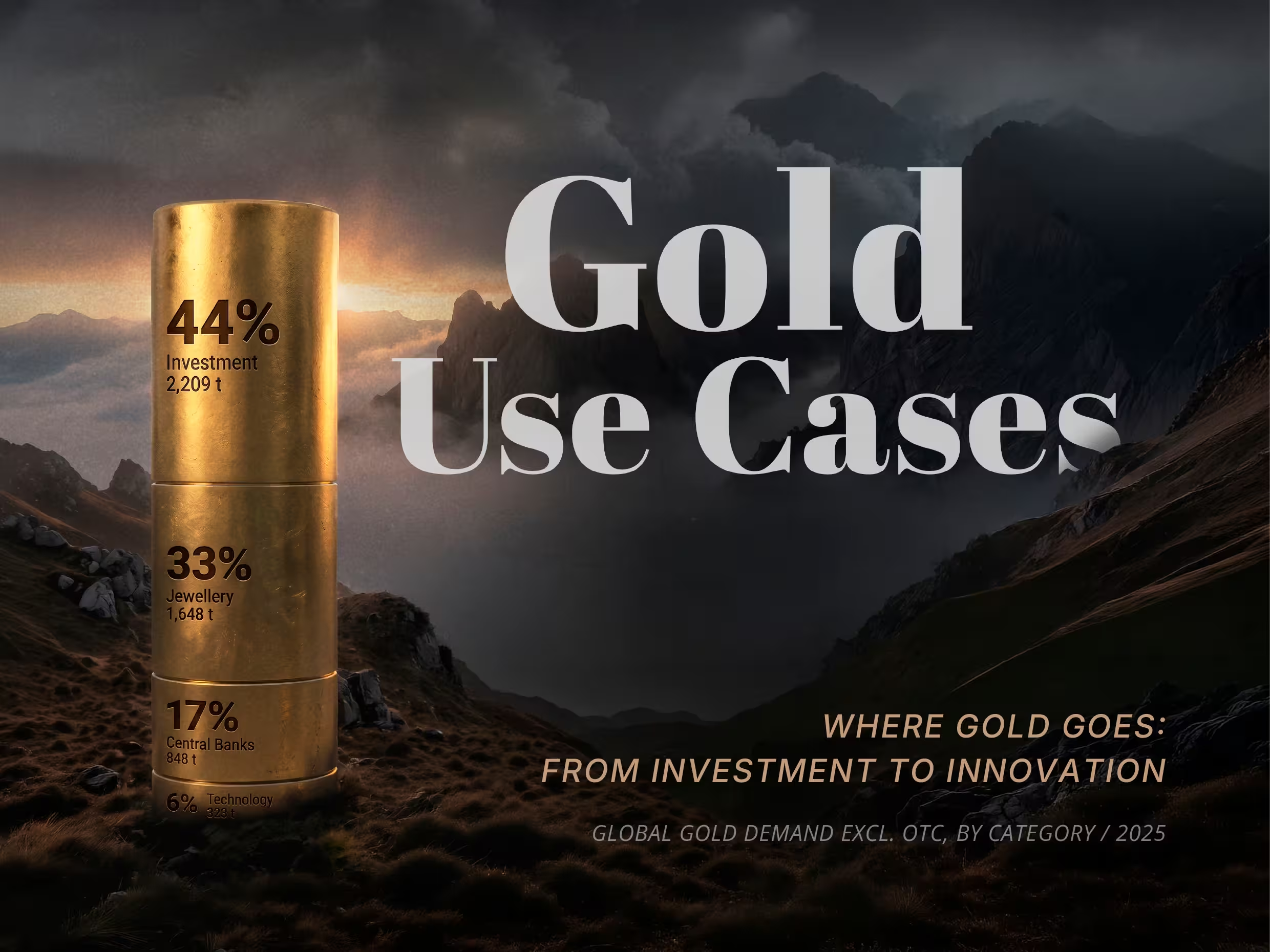
On June 16, 2026, the World Gold Council published its annual survey of central banks. A record 45% of the 76 respondents said they plan to increase their own gold holdings over the next 12 months, and 89% expect global central bank holdings to rise, according to the council. Central banks are one of four uses for the gold bought each year, and the balance between them has changed. In 2010, jewellery took 49% of demand and investment 39%, according to the council's data tables. In 2025, the order reversed: investment took 44% and jewellery 33%.
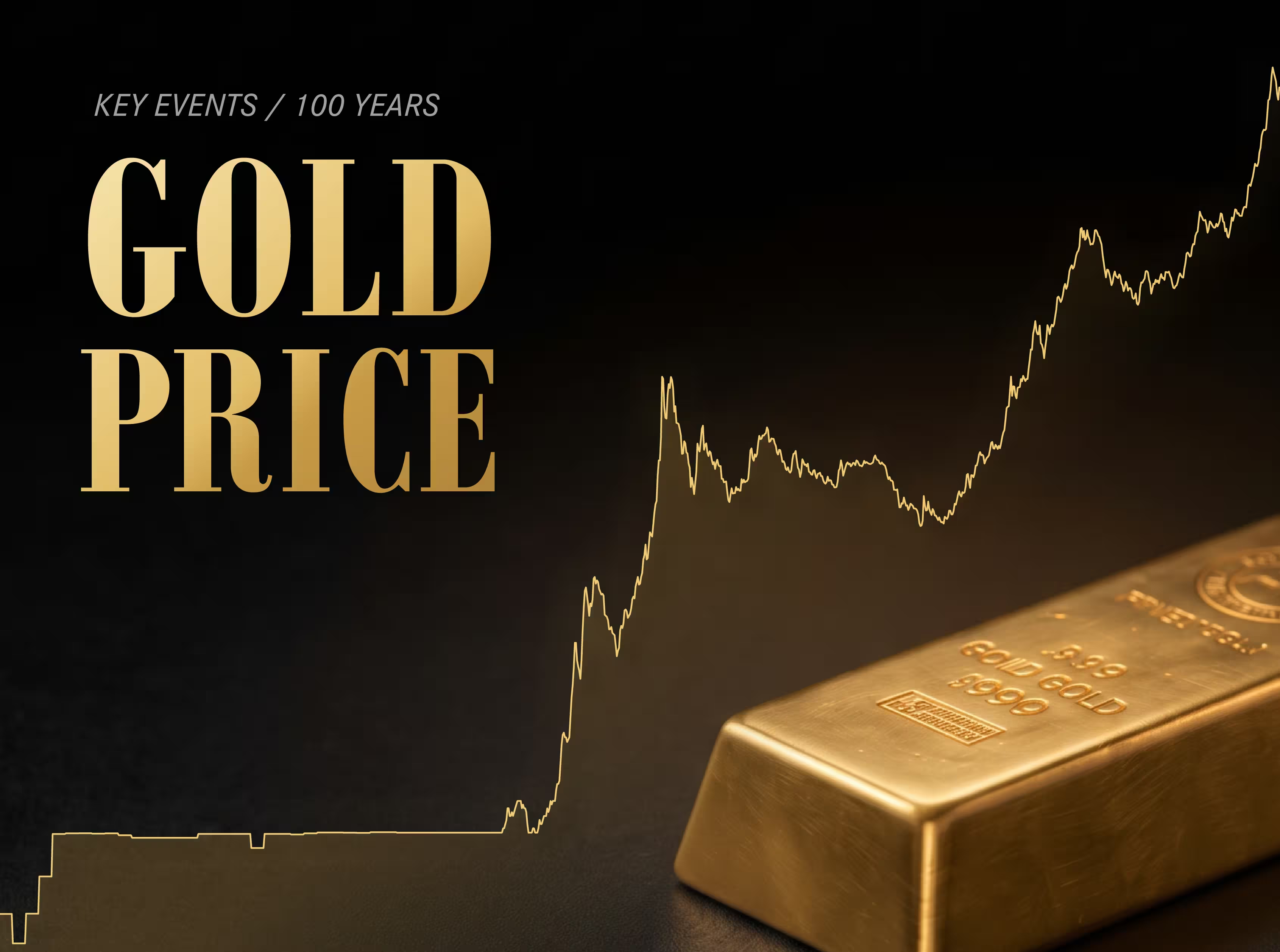
In 1934, the US government set the price of gold at $35 an ounce. In September 2026, the market price averaged $4,319. Measured in today's money, gold has done more than keep up with rising prices. An ounce is now worth almost five times what it was when the price was set in 1934, and more than at the famous 1980 peak. For the companies that mine it, that has meant record margins.

The largest silver producer among the world's primary silver mines in 2025 sat not in Mexico but in southwestern Bolivia. San Cristóbal, a large open-pit silver-zinc-lead mine run by Minera San Cristóbal, produced 17.6 million ounces of silver, narrowly ahead of Mexico's Juanicipio at the same rounded figure, in new Metals Focus data on the 20 largest primary silver mines. These are the operations where silver is a defining product rather than an incidental byproduct of lead, zinc and gold. The list runs from centuries-old mines in Mexico's silver belt to remote sites in the Andes, the Australian outback and the Alaskan wilderness. Eight of the 20 sit in Mexico, together about 44% of the total, while the rest are spread across the Americas, Asia, Africa and Australia.
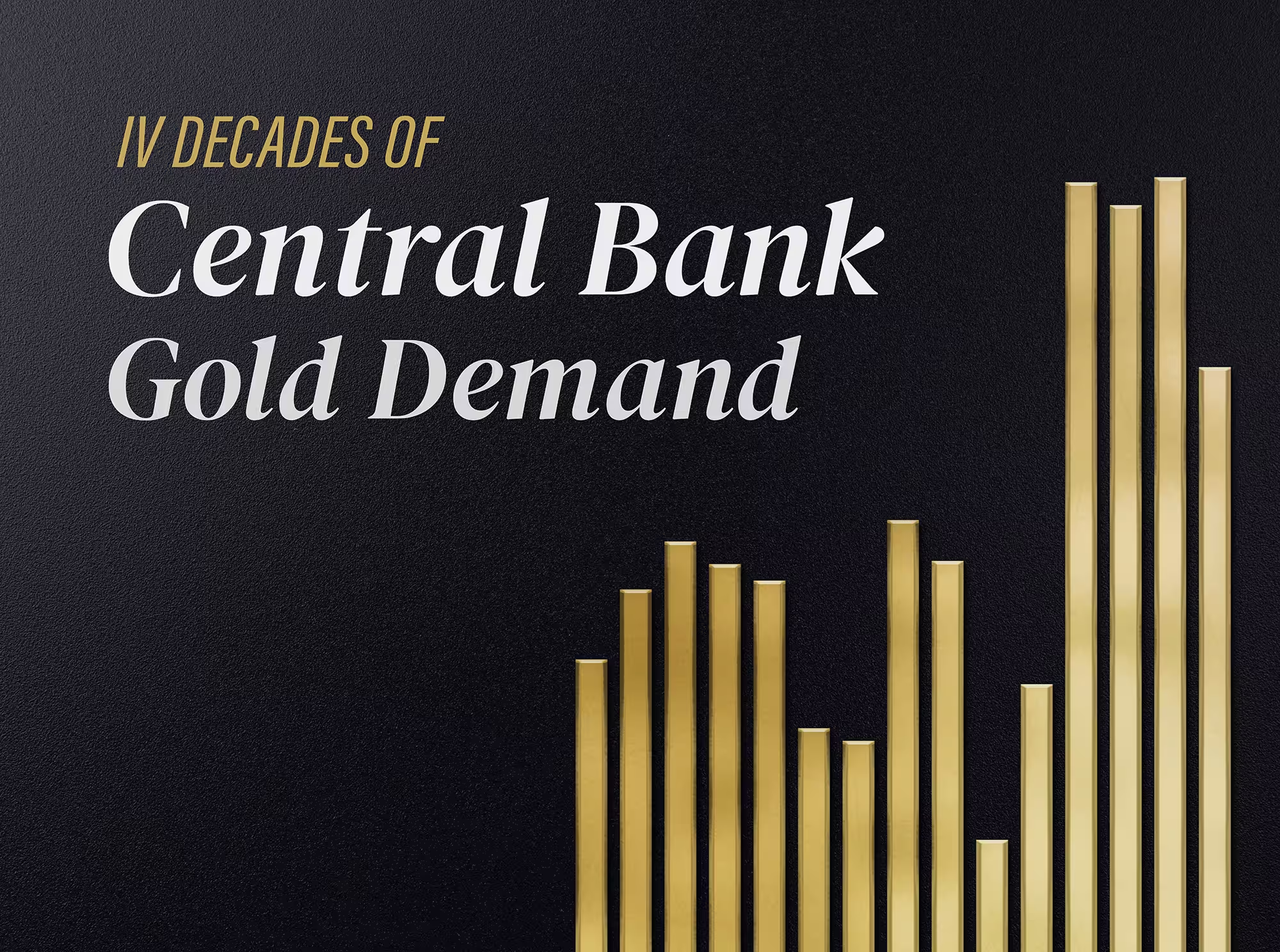
Central banks bought more gold between April and June 2026 than in any second quarter on record, according to a World Gold Council report published on July 30. That keeps them net buyers this year, as they have been every year since 2010. Underneath, the picture is changing. Russia and Türkiye, both big buyers in the past, have been selling.