Precious Metals
How the World's Use of Gold Has Shifted Since 2010
IN 2010, NEARLY HALF OF ALL GOLD BOUGHT BECAME JEWELLERY. ANOTHER USE NOW LEADS
The following content is sponsored by Galiano Gold
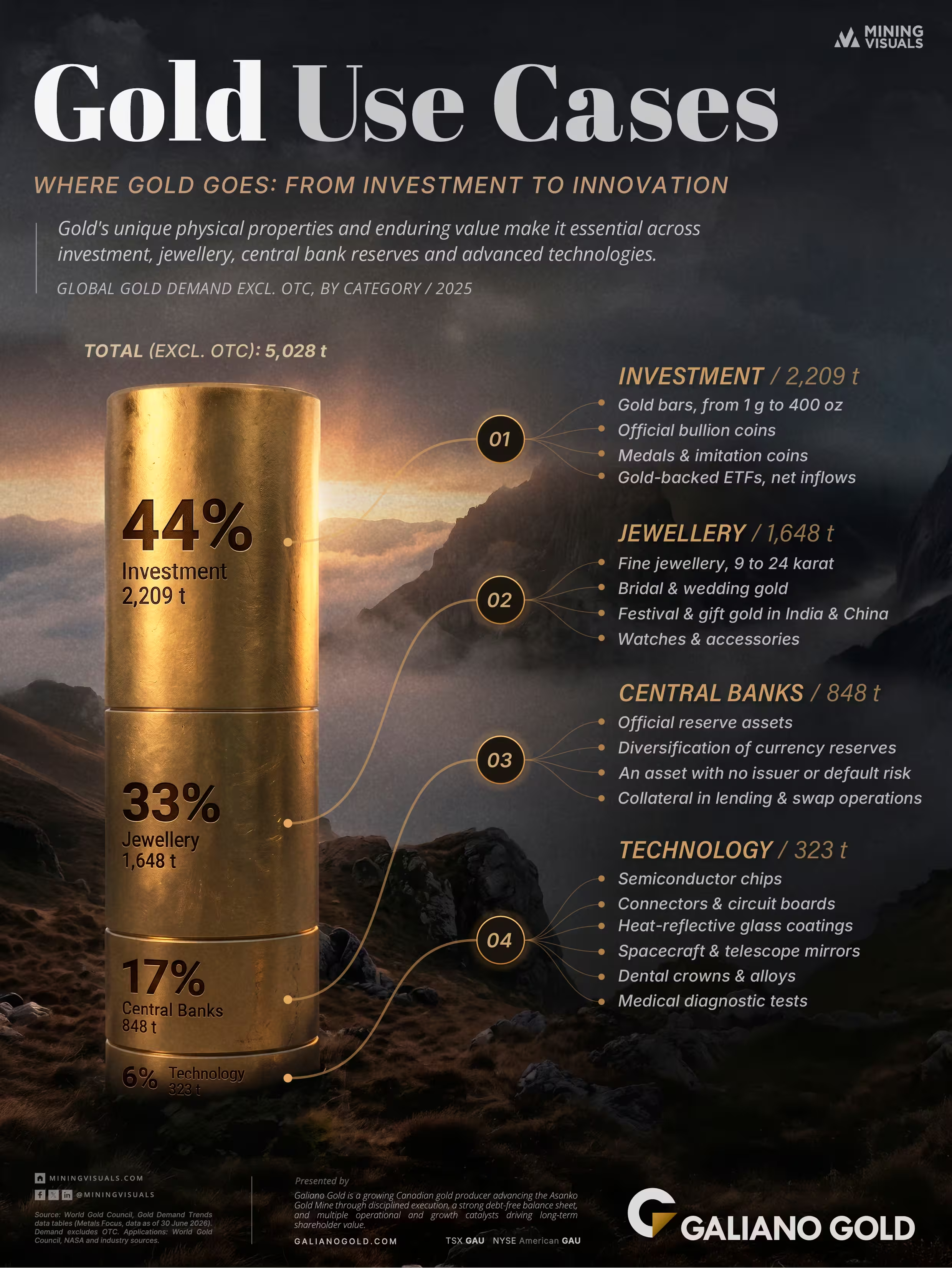

Investment Overtook Jewellery: Investment took 44% of gold demand in 2025, up from 39% in 2010, while jewellery's share moved from 49% to 33%, per World Gold Council data.
Record Spending on Jewellery: Jewellery buyers spent a record US$172 billion on gold pieces in 2025.
48 Grams on Webb’s Mirror: The James Webb Space Telescope’s primary mirror carries about 48 grams of gold, chosen for its infrared reflectivity.
On June 16, 2026, the World Gold Council published its annual survey of central banks. A record 45% of the 76 respondents said they plan to increase their own gold holdings over the next 12 months, and 89% expect global central bank holdings to rise, according to the council.
Central bank reserves are one of the four ways the gold bought each year is used, alongside investment, jewellery and technology, and the balance between them has changed. In 2010, jewellery took 49% of demand and investment 39%, according to the council’s data tables. In 2025, the order reversed: investment took 44% and jewellery 33%.
Investors bought 1,098 tonnes of gold bars in 2025, more than in any year since 2013, the council’s data tables show. In China, people bought more gold as bars and coins than as jewellery for the first time in the council’s records, according to its investment review.
Gold ETFs are funds that buy and store physical gold for their investors, and they change direction quickly. In 2024 they shrank by 3 tonnes, and in 2025 they grew by 803 tonnes. This year they lost 45 tonnes between April and June, then gained 211 tonnes between July and September. At the end of September, they held 4,256 tonnes of gold, more than ever before.
Jewellery buyers spent a record US$172 billion in 2025, 18% more than the year before, the council reports. Because the average gold price rose 44%, that money bought 18% less gold, 1,542 tonnes, the lowest in five years. Buyers kept spending and adjusted what they bought instead: lighter Hard Pure gold in China, lower-carat pieces in South Korea and Indonesia. The graphic's 1,648 tonnes is jewellery fabrication, which includes 113 tonnes that manufacturers and retailers added to stock. Spending kept rising in 2026, up 14% to US$40 billion in the second quarter, per the council's Q2 report.
Central banks bought 79 tonnes in 2010, under 2% of demand, and 848 tonnes in 2025, or 17%, after a peak share of 23% in 2024. Our October 5 article traced how they became net buyers. The banks give their own reasons in the council's survey: 90% cited gold's performance during crises, 84% its role as a long-term store of value and 82% portfolio diversification.
Electronics used 270 tonnes of gold in 2025, with AI computing increasing the use of bonding wire and interconnect materials. Technology demand rose 2% to 80 tonnes in the second quarter of 2026, and the council describes AI infrastructure as the dominant growth engine for high-end electronics.
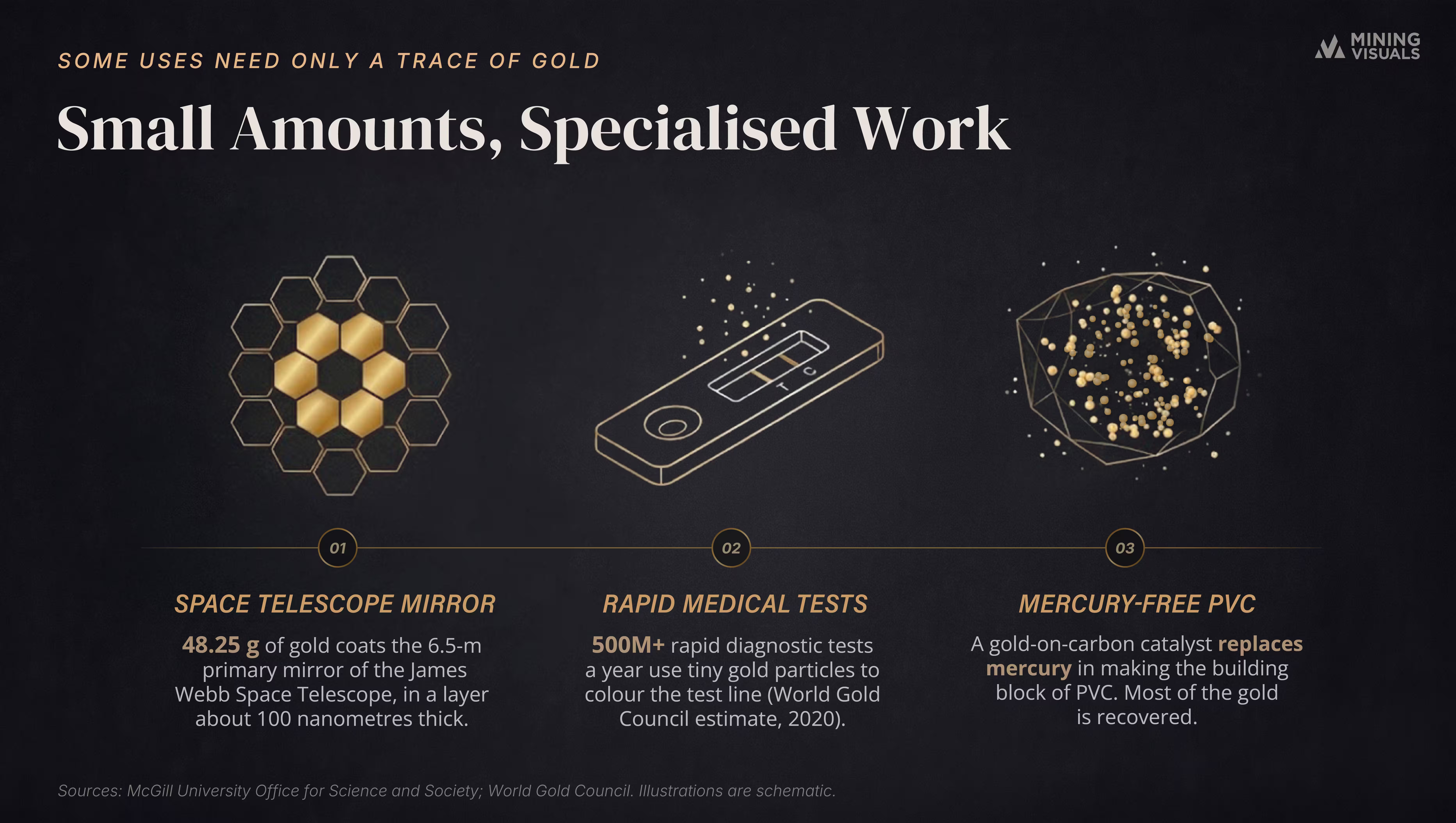
The James Webb Space Telescope's 6.5-metre primary mirror carries just 48.25 grams of gold, a layer about 100 nanometres thick, per McGill University's Office for Science and Society. Gold reflects about 99% of infrared light, against 85% to 95% for the silver and aluminium mirrors used on Earth. For scale, the 44 tonnes of gold that went into other industrial uses in 2025 would be enough to coat Webb's mirrors more than 900,000 times.
In rapid diagnostic tests, tiny gold particles collect on the test line and turn it deep purple, and the World Gold Council estimated in 2020 that annual volumes comfortably exceed half a billion tests. In chemistry, Johnson Matthey has built a production line in Shanghai for a gold catalyst that replaces mercury in making the building block of PVC, an industry that in China used roughly a quarter of the world's mercury. Most of the gold in the catalyst is recovered and recycled.

Galiano Gold Inc. (TSX: GAU) (NYSE American: GAU) is building momentum at the Asanko Gold Mine in Ghana, West Africa. With a strong, debt-free balance sheet, disciplined execution, and multiple operational and growth catalysts ahead, Galiano is focused on strengthening cash flow generation, growing Mineral Resources and Mineral Reserves, extending mine life, and delivering long-term shareholder value.
As a Canadian gold producer, Galiano is committed to responsible mining and sustainable value creation while contributing to Ghana's economic development through local employment, procurement, and community investment.
Learn more at www.galianogold.com.
MiningVisuals Disclaimer: This article is for informational purposes only and does not constitute financial or investment advice. Always conduct your own research.

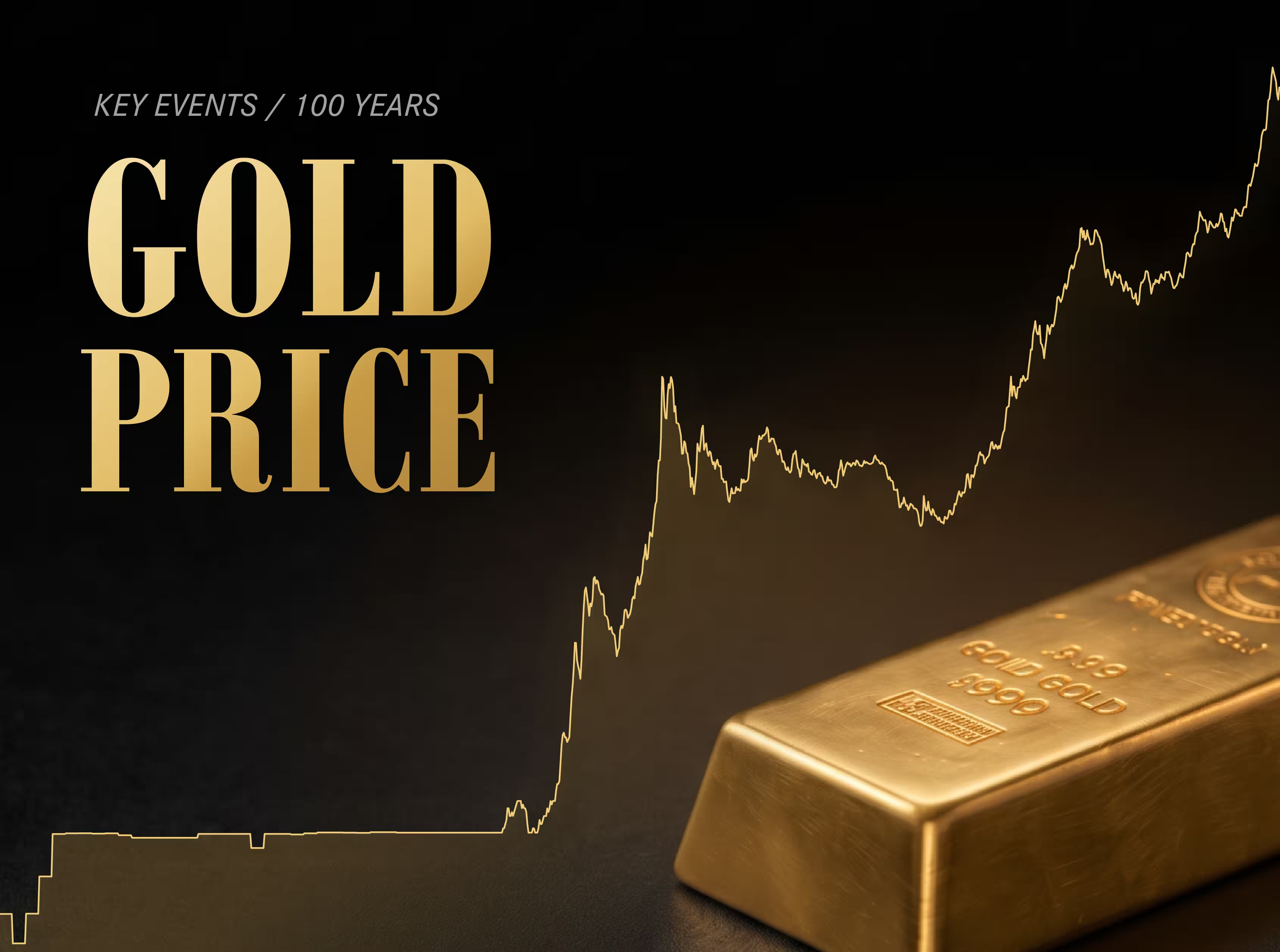
In 1934, the US government set the price of gold at $35 an ounce. In September 2026, the market price averaged $4,319. Measured in today's money, gold has done more than keep up with rising prices. An ounce is now worth almost five times what it was when the price was set in 1934, and more than at the famous 1980 peak. For the companies that mine it, that has meant record margins.

The largest silver producer among the world's primary silver mines in 2025 sat not in Mexico but in southwestern Bolivia. San Cristóbal, a large open-pit silver-zinc-lead mine run by Minera San Cristóbal, produced 17.6 million ounces of silver, narrowly ahead of Mexico's Juanicipio at the same rounded figure, in new Metals Focus data on the 20 largest primary silver mines. These are the operations where silver is a defining product rather than an incidental byproduct of lead, zinc and gold. The list runs from centuries-old mines in Mexico's silver belt to remote sites in the Andes, the Australian outback and the Alaskan wilderness. Eight of the 20 sit in Mexico, together about 44% of the total, while the rest are spread across the Americas, Asia, Africa and Australia.
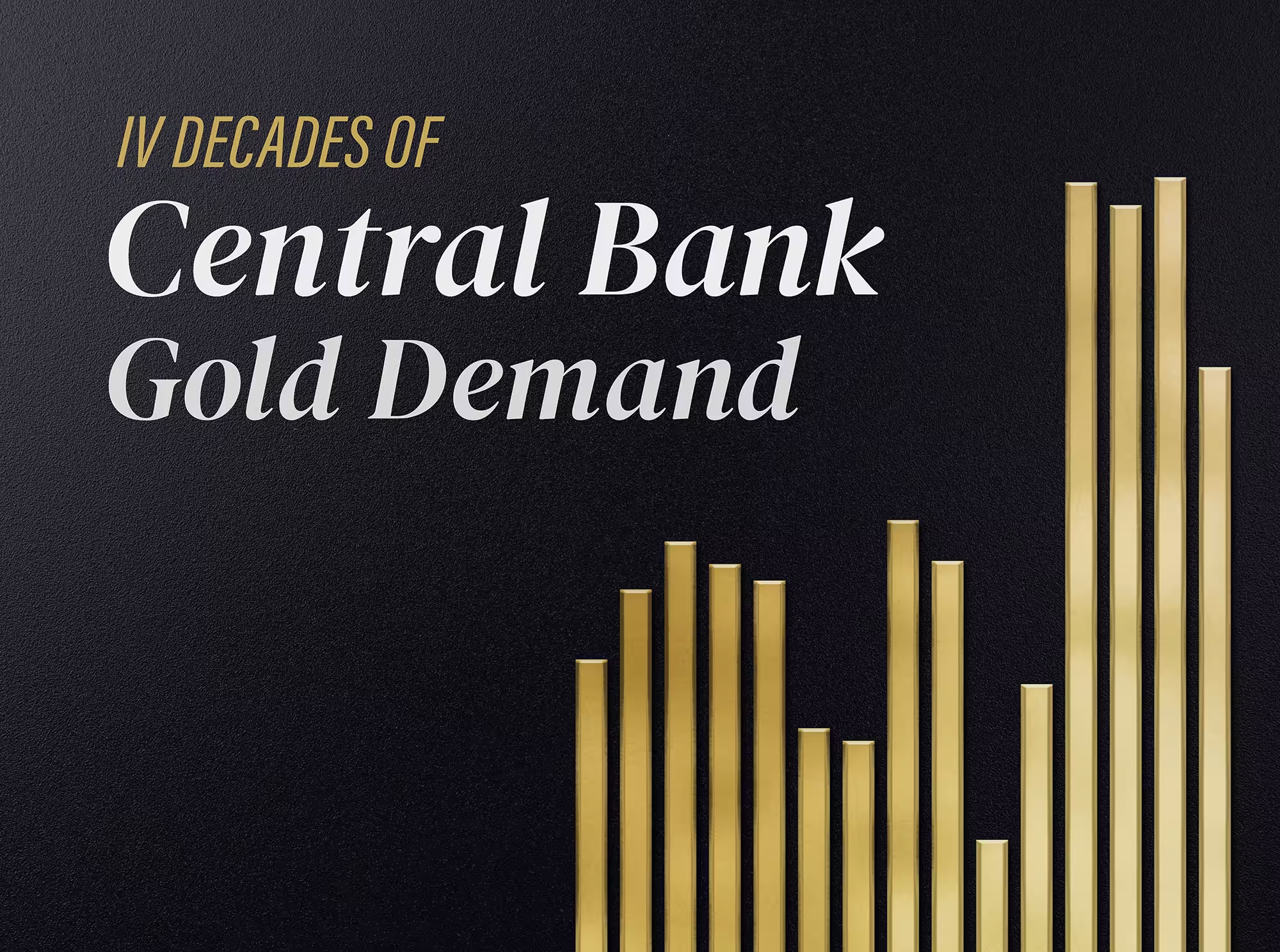
Central banks bought more gold between April and June 2026 than in any second quarter on record, according to a World Gold Council report published on July 30. That keeps them net buyers this year, as they have been every year since 2010. Underneath, the picture is changing. Russia and Türkiye, both big buyers in the past, have been selling.

The nine West African countries with significant reported output produced about 15% of the world's mined gold in 2025, according to Metals Focus and World Gold Council data. Almost every mine on the map above was built in the past 25 years, and four more reached production in the last eighteen months: Lafigué in Côte d'Ivoire in June 2024, Kiaka in Burkina Faso in June 2025, Ahafo North in Ghana in October 2025 and Kiniero in Guinea in December 2025.