Commodities
May 28, 2026
1 min
Commodities

Key takeaways
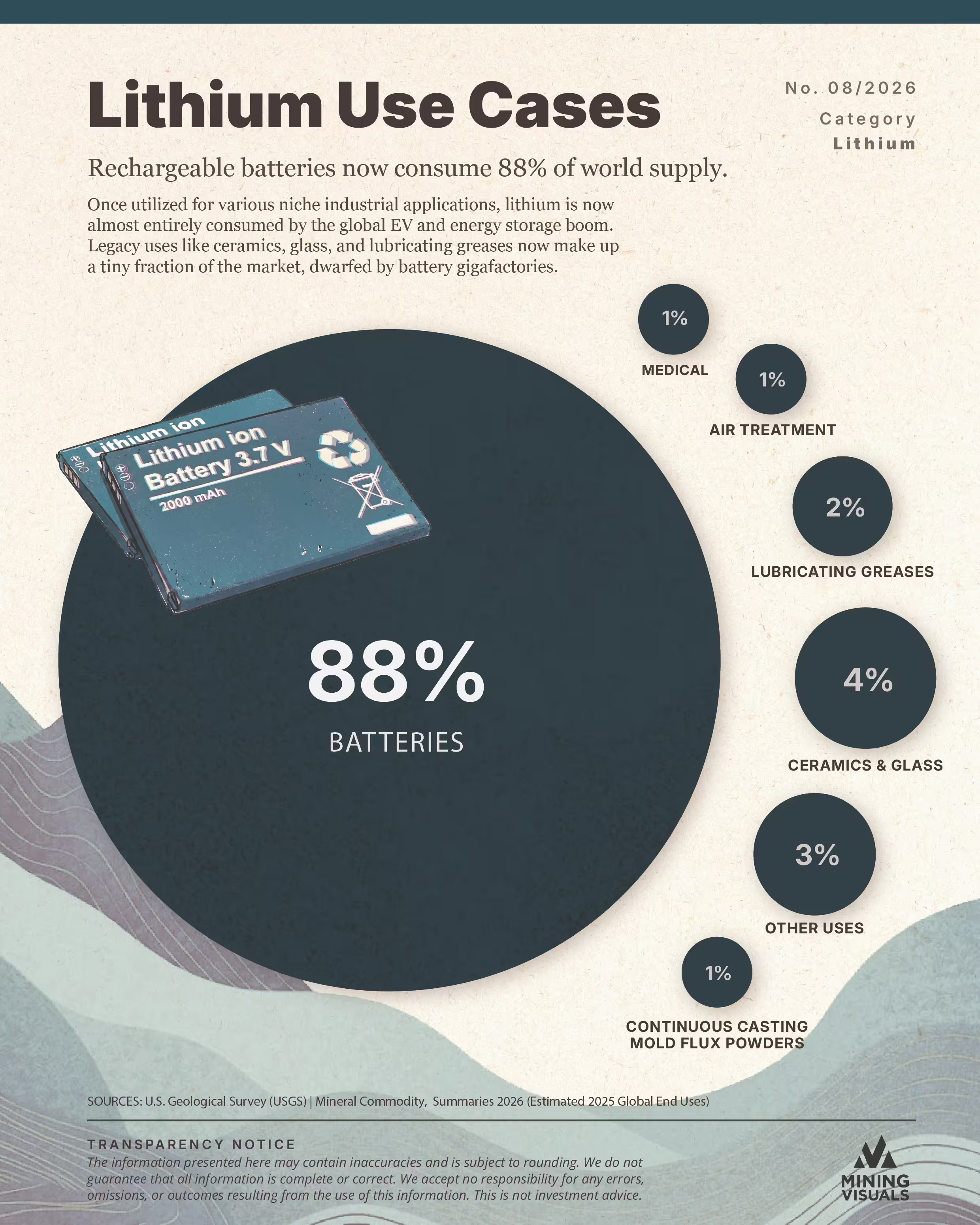
- Batteries dominate at 88%: USGS Mineral Commodity Summaries 2026 estimates batteries at 88% of global lithium end-use, with every other category at 4% or less.
- EVs and storage are the engine: The IEA reports that EVs and battery storage together make up around 90% of today's lithium-ion battery market, with total Li-ion deployment up more than sixfold between 2020 and 2025.
- Legacy and medical uses are now slivers: Ceramics and glass (4%), lubricating greases (2%), air treatment (1%), casting flux powders (1%) and medical use (1%) together account for less than one-eighth of demand, per USGS.
In February 2026, the U.S. Geological Survey put a fresh number on a transformation that has been building for a decade: batteries now account for 88% of global lithium end-use, up from 87% a year earlier. The metal that once quietly toughened ceramics and thickened industrial greases has been almost entirely repurposed by the battery economy. As covered in our reporting on the shift from surplus to deficit, the supply side of this story is tightening. The demand side is now strikingly simple. According to the same USGS data, global lithium consumption rose 20% in 2025 to roughly 263,000 tons, and the overwhelming share of that growth points in one direction: cells.
The Battery Era
The headline figure is the story. USGS attributes the 88% battery share to the growth of rechargeable lithium batteries across electric vehicles, energy grid storage, portable electronics and electric tools. The scale of that growth is documented by the IEA, which finds that EVs and battery storage now represent roughly 90% of the lithium-ion battery market, and that total Li-ion deployment across all applications rose more than sixfold from 2020 to 2025.
Demand is following. The IEA's Global Critical Minerals Outlook records that lithium demand grew by nearly 30% in 2024, and that for battery metals the energy sector accounted for 85% of total demand growth. Chemistry is shifting underneath that demand too: the IEA notes lithium iron phosphate (LFP) batteries now cover close to half the electric-car market, up from under 10% in 2020.
The Legacy Uses That Remain
Before the battery boom, lithium was a specialist's material, and those uses have not disappeared so much as been overshadowed. USGS places ceramics and glass at 4%, where lithium minerals are added directly as mineral concentrates to improve heat resistance and reduce thermal expansion. Lubricating greases follow at 2%, valued for performance across wide temperature ranges. Air treatment sits at 1%, where lithium compounds absorb carbon dioxide and control humidity in enclosed environments, and continuous casting mold flux powders account for another 1% in steelmaking. USGS also notes that substitutes such as calcium and aluminum soaps in greases, or sodic and potassic fluxes in glass and ceramics, remain available for several of these applications.
The 1% That Reshaped Psychiatry
A single percent of global lithium supply goes to medicine, but its impact is disproportionate to its volume. The NHS prescribing guidance describes lithium as the most effective long-term treatment for bipolar disorder, reducing the frequency, duration and severity of relapses as well as suicidal acts, suicide and overall mortality. The Mayo Clinic records its use in treating mania and reducing the frequency and severity of manic episodes. It is a reminder that lithium's value was established in clinical settings long before it became a battery input.
Final Synthesis: A Metal With One Master
The diversification that once defined lithium has effectively collapsed into a single dominant use. With batteries at 88% and climbing, the metal's fortunes are now tied almost entirely to electrification. The IEA projects that under its Stated Policies Scenario, lithium demand grows fivefold from today to 2040. Set against the tightening supply picture from our earlier analysis, the concentration of demand into one application is what makes lithium so strategically sensitive. When 88% of a commodity serves one purpose, the health of that single sector is, increasingly, the health of the entire market.
MiningVisuals Disclaimer: This article is for informational purposes only and does not constitute financial or investment advice. Always conduct your own research.
Sources:
- U.S. Geological Survey — Mineral Commodity Summaries 2026, Lithium
- U.S. Geological Survey — Lithium overview
- IEA — Global EV Outlook 2026, Electric vehicle batteries
- IEA — Global Critical Minerals Outlook 2025, Executive summary
- IEA — Global Critical Minerals Outlook 2025, Overview of outlook for key minerals
- NHS / NICE-aligned Lithium Prescribing Guideline
- Mayo Clinic — Lithium (oral route)




Explore More
View All

Behind Tin's 2026 Record High
Behind Tin's 2026 Record High
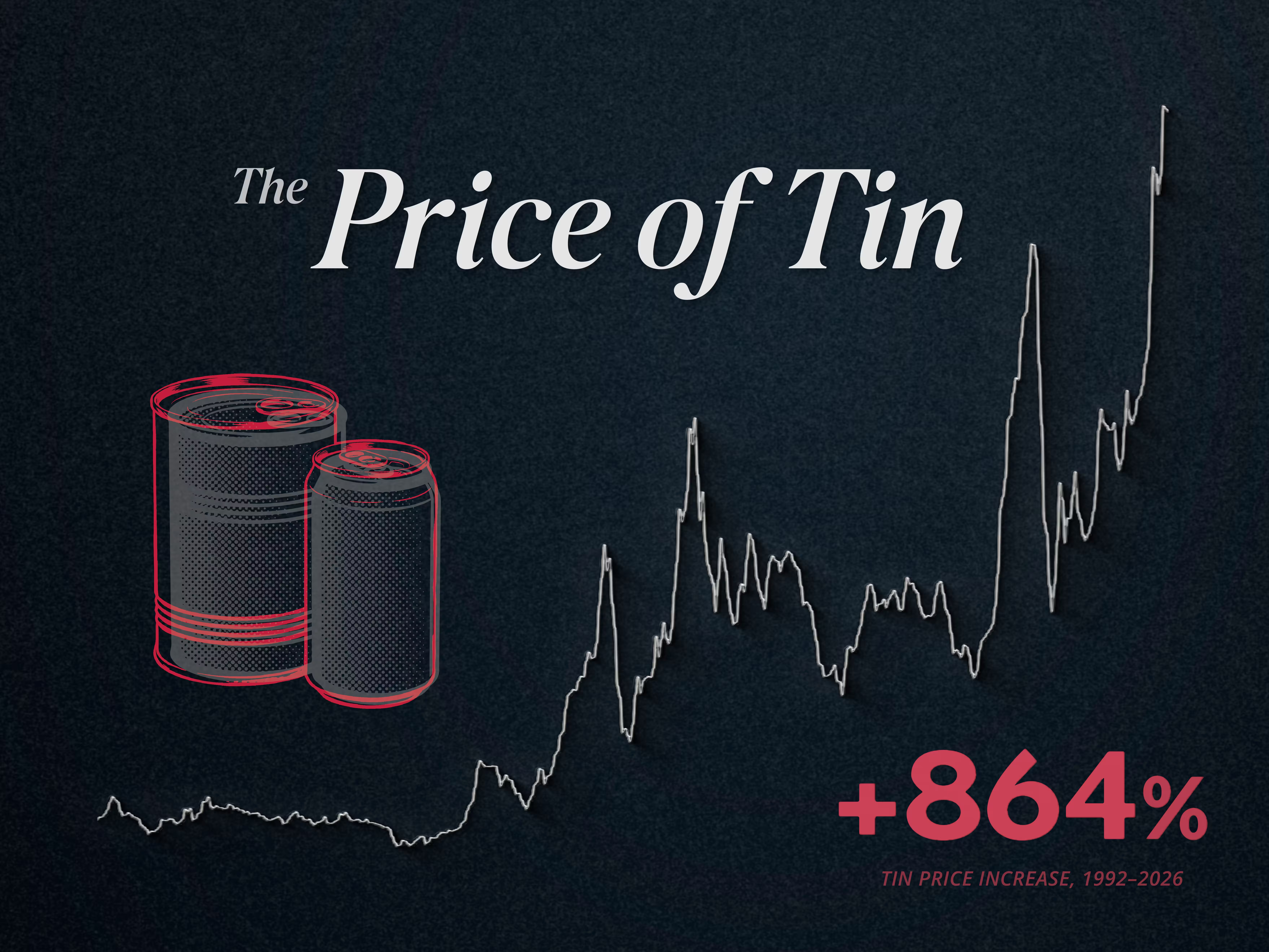
In January 2026, the London Metal Exchange three-month tin contract closed at US$53,462 a tonne, a nominal all-time high that surpassed the March 2022 peak, and it has traded near those levels since. The puzzle is that there is no shortage of tin today: exchange inventories actually rose as the price climbed, rather than being drawn down. Two very different things are holding the price up. The first is short-term: a wave of investor buying, which the industry says drove the January jump. The second is long-term: on current forecasts, the world will not mine enough tin to meet demand later this decade, a gap already projected before the rally began and expected to persist after it fades. The lasting story is that forecast shortfall, not the spike.
Lead Powers the World's Batteries, and Its Map of Demand Is Shifting East
Lead Powers the World's Batteries, and Its Map of Demand Is Shifting East
You are probably within a few feet of some lead right now. It sits in the starter battery of nearly every car, electric models included, in the backup power rooms of hospitals and data centres, and behind the walls of every X-ray suite. It is also the most recycled product in the United States, recovered mostly from spent batteries. So it came as a surprise to many when Washington added lead to its Final 2025 List of Critical Minerals in November, a label usually reserved for metals in short supply. Lead is not in short supply
The Age of Giants: How Mining Shovels Grew, Peaked, and Deliberately Shrank
The Age of Giants: How Mining Shovels Grew, Peaked, and Deliberately Shrank
For four decades, the American coalfields hosted an engineering arms race measured in cubic metres of bucket. It ended not with a bigger machine, but with a deliberate retreat. The single largest mobile land machine ever built, the Marion 6360 "Captain," was commissioned in 1965 and destroyed by fire in 1991. No shovel has approached its scale since, and the machines that replaced it were smaller by design.
Where Indium Goes: The Metal Behind Screens, Chips, and Solar
Where Indium Goes: The Metal Behind Screens, Chips, and Solar
Indium is one of the metals you never see but use constantly. As indium tin oxide, it forms the transparent conductive coating on nearly every LCD and touchscreen, and that single application still accounts for most global consumption, according to the USGS. But the metal's role is broadening. Its compounds now sit inside the high-speed optical chips that route data through AI data centers, a shift that has turned a quiet, display-driven material into one buyers watch closely, especially as China refines about 70% of it and has begun tightening the flow.