Commodities
May 25, 2026
2 min
Commodities
The following content is sponsored by Eloro Resources

Key takeaways
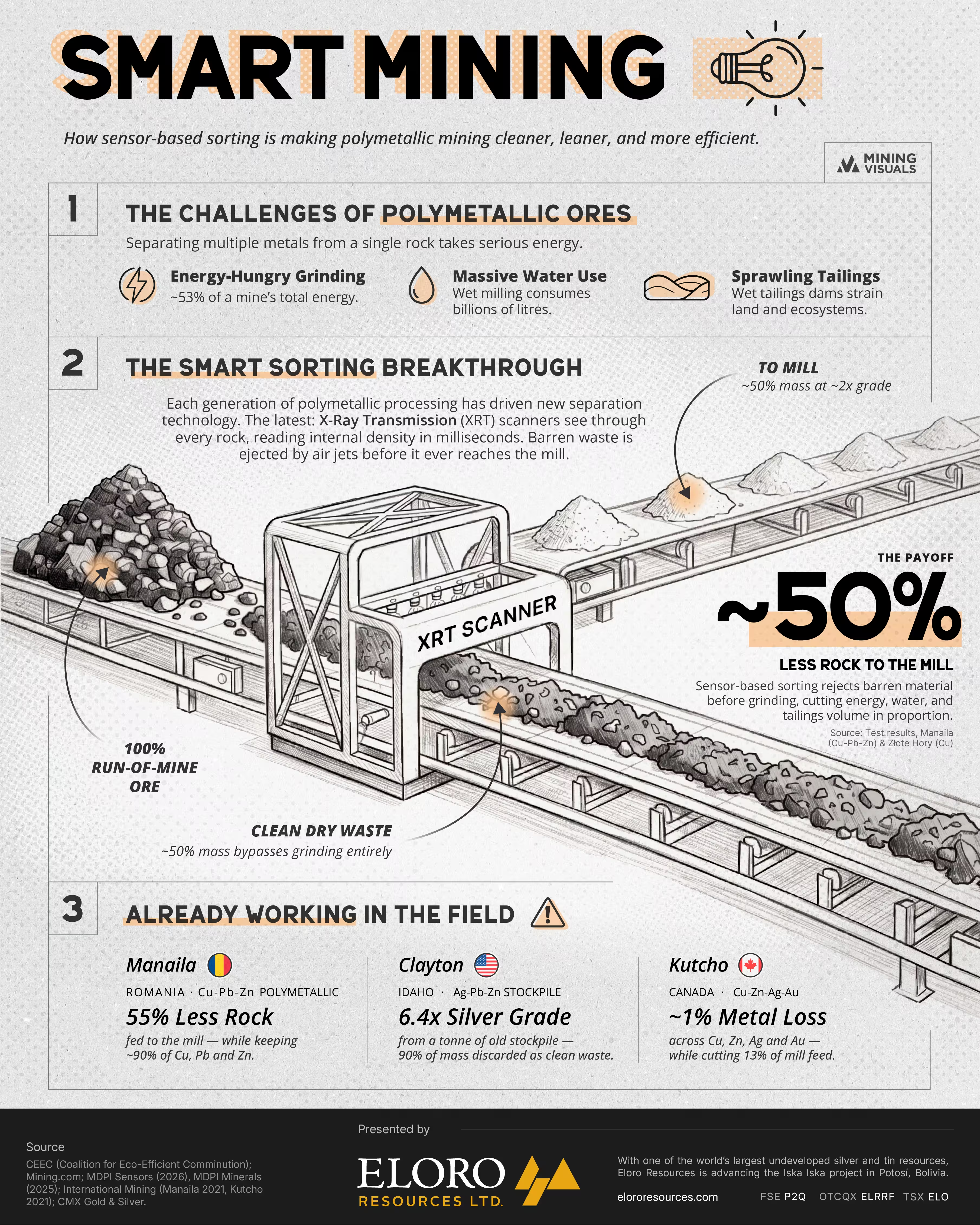
- Comminution — crushing and grinding ore — consumes around 53% of a metal mine's total energy and roughly 3% of all electricity generated worldwide.
- An independent peer-reviewed analysis in MDPI's Minerals journal found XRT sorting can reduce capital and operating costs by up to 20% by rejecting barren rock before the mill.
- Polymetallic operations confirm the model: at Vast Resources' Manaila mine in Romania, XRT recovered 93% of copper, 82% of lead, and 92% of zinc in just 45% of the original mass.
Sensor-based sorting lets miners reject barren rock before it's ever crushed, saving energy, water, and tailings volume at industrial scale.
Polymetallic deposits, the orebodies that carry multiple economically valuable metals in a single rock, present a distinctive processing challenge: the valuable minerals are locked together with each other and with vast volumes of barren rock, demanding both heavy grinding and complex multi-stage separation. That complexity is one reason polymetallic operations have become early adopters of sensor-based pre-concentration. The traditional fix is to grind all of it to powder and let chemistry sort it out, a step that consumes around 53% of a typical mine's total energy.
A quieter technology is rewriting that math: X-Ray Transmission (XRT) sorting. It reads the density of every rock on the belt in milliseconds and ejects the barren ones before they ever reach the mill.
What XRT Actually Does
As ore moves across a high-speed belt, X-rays penetrate each particle and a detector reads the rock's internal density in milliseconds. Dense, metal-bearing rocks are flagged. High-pressure air jets eject the barren ones into a separate waste stream before they ever reach the energy-intensive wet plant. The technology is supplied by several competing vendors including TOMRA, Comex, Steinert, and Redwave, and an independent peer-reviewed economic analysis published in MDPI's Minerals found that XRT sorting can reduce capital and operating costs by up to 20%.
Two material streams come out instead of one: a smaller, richer feed for the mill, and a clean, dry waste stream that bypasses grinding, water, and tailings dams entirely. The energy logic follows directly from the mass logic. Every tonne of barren rock rejected before the mill is a tonne that never gets ground.
Independent Test Results
Academic research is now catching up with vendor claims. A 2026 peer-reviewed study published in MDPI's Sensors journal tested low-grade European copper ore from the Złote Hory mine in the Czech Republic using a dual-energy XRT laboratory sorter. The study reported 95.67% copper recovery in 52% of the original mass, with the waste stream falling to just 0.04% copper. The pre-concentrate grade was 1.82× the feed grade. Critically, the study was not commissioned by a sorting vendor.
The same line of academic work has extended to gold, lithium spodumene, and complex sulphide ores, with researchers increasingly combining XRT with other sensor modalities and machine vision to handle ore types that were previously considered unsortable.
Polymetallic Operations Already Using It
Manaila, Romania. Vast Resources' Cu-Pb-Zn polymetallic sulphide mine ran a feasibility study with XRT pre-concentration. International Mining reports test results for the mine's typical disseminated-to-massive sulphide ore: 93.1% of copper, 82.2% of lead, and 92.4% of zinc recovered in just 45% of the original mass. More than half the rock could be rejected before milling while retaining the great majority of payable metal.
Clayton Silver Mine, Idaho. CMX Gold & Silver tested XRT on a one-million-tonne historical Ag-Pb-Zn stockpile. Published test results show the sorter recovered more than 70% of the stockpile's metals in just 10% of the original mass, upgrading the silver grade by 6.4× and the lead and zinc grades by 7×.
Kutcho, Canada. Kutcho Copper's Cu-Zn-Ag-Au project tested XRT on bulk samples from its Main and Esso deposits. International Mining reports the test work rejected 13% of run-of-mine material before milling while recovering approximately 99% of the copper, zinc, silver and gold reporting to the sorter, a smaller mass cut, but near-zero metal loss.
The Bottom Line
Polymetallic processing has historically been an exercise in grinding everything and chemically sorting what's left. Sensor-based sorting flips the sequence: physically sort what you can, then grind what's worth grinding. With falling grades and rising energy bills, the question for operators is shifting from whether sensor-based sorting belongs in their plant to which sensor, and at what cut-point. The complexity of polymetallic ore, long a constraint, is becoming the proving ground for cleaner mining.
Sponsored by:

Eloro Resources Ltd. is a mineral exploration company advancing a world-class silver and tin project in Bolivia’s historic Potosí Department. Its flagship asset, the Iska Iska Project, ranks among the top five undeveloped global resources in terms of scale for both tin and silver.
This significant grassroots discovery remains open in multiple directions, offering substantial potential for continued expansion and resource enhancement. Iska Iska benefits from strong infrastructure access and a deeply rooted presence in Bolivia, supported by an experienced management team and meaningful community engagement.
Eloro’s strategy is focused on resource growth, strategic partnerships, and establishing a leading position within the global mining sector.
Learn more about Eloro Resources at: http://elororesources.com/
Sources:
- Mining.com — Grinding down energy consumption in comminution
- MDPI Minerals — From Single-Sensor Constraints to Multisensor Integration (2025)
- MDPI Sensors — Comparative Analysis of Selective Mining and XRT Sensor-Based Sorting for Copper Ore Pre-Concentration (2026)
- International Mining — Vast sees path forward at Manaila with help of TOMRA's XRT ore sorting solution (Oct 2021)
- CMX Gold & Silver — Clayton Stockpile Ore-Sorting Program
- International Mining — TOMRA XRT ore sorting test work delivers the goods at Kutcho's copper-zinc project (Sept 2021)
MiningVisuals Disclaimer: This article is for informational purposes only and does not constitute financial or investment advice. Always conduct your own research. Case studies referenced (Manaila, Clayton, and Kutcho) describe other operations and do not represent results from Eloro Resources' projects.



Explore More
View All

Behind Tin's 2026 Record High
Behind Tin's 2026 Record High
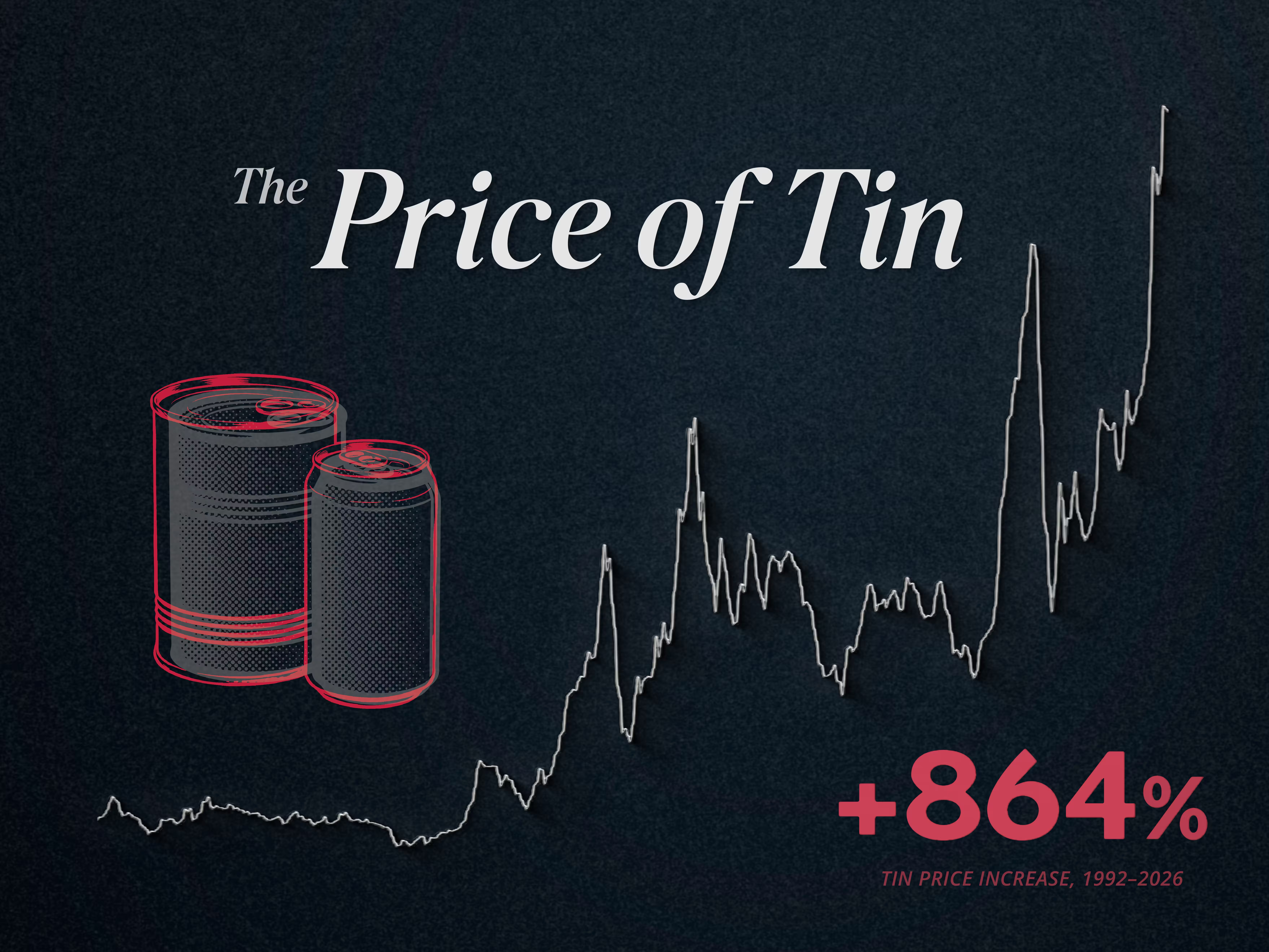
In January 2026, the London Metal Exchange three-month tin contract closed at US$53,462 a tonne, a nominal all-time high that surpassed the March 2022 peak, and it has traded near those levels since. The puzzle is that there is no shortage of tin today: exchange inventories actually rose as the price climbed, rather than being drawn down. Two very different things are holding the price up. The first is short-term: a wave of investor buying, which the industry says drove the January jump. The second is long-term: on current forecasts, the world will not mine enough tin to meet demand later this decade, a gap already projected before the rally began and expected to persist after it fades. The lasting story is that forecast shortfall, not the spike.
The Age of Giants: How Mining Shovels Grew, Peaked, and Deliberately Shrank
The Age of Giants: How Mining Shovels Grew, Peaked, and Deliberately Shrank
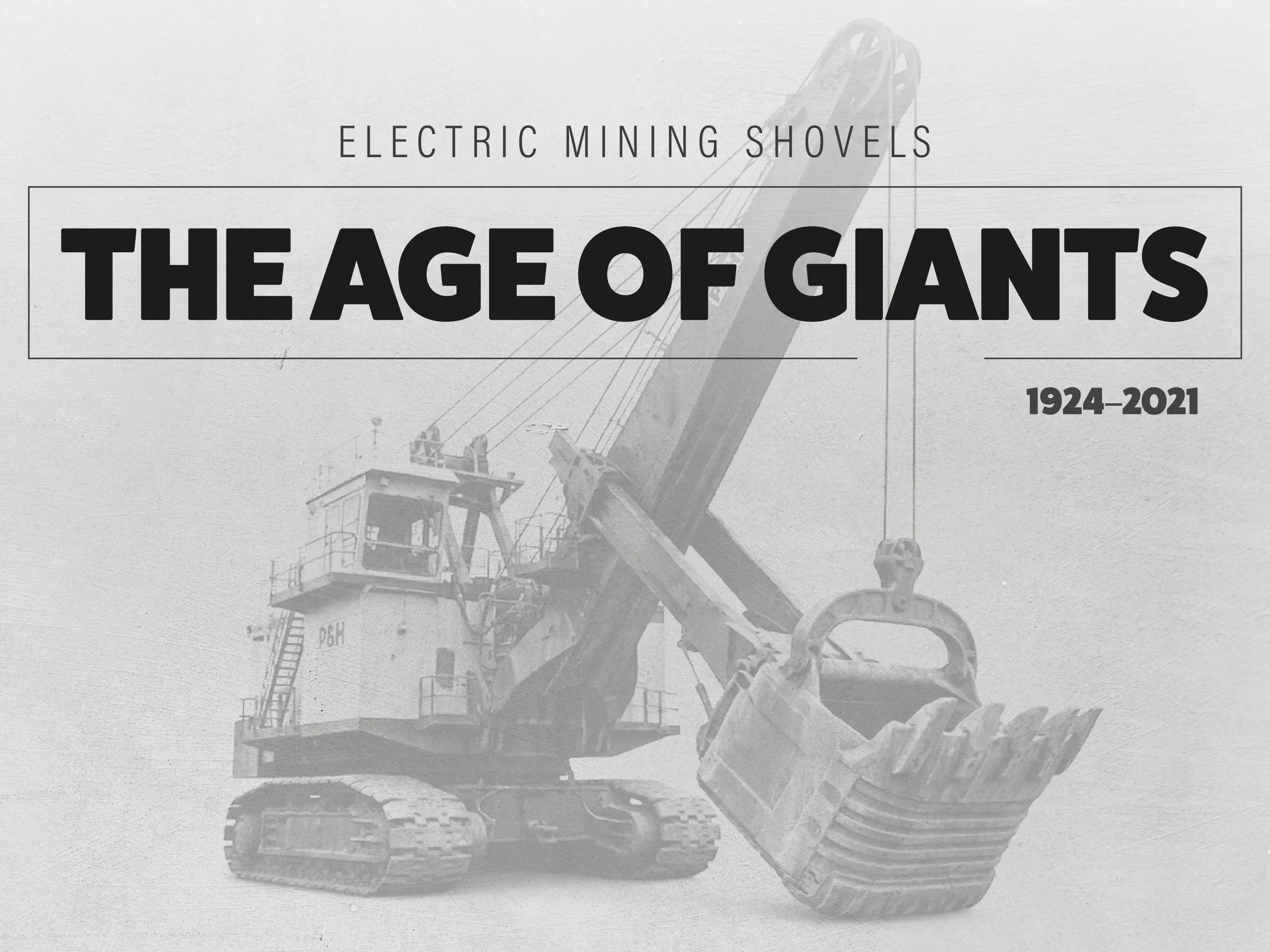
For four decades, the American coalfields hosted an engineering arms race measured in cubic metres of bucket. It ended not with a bigger machine, but with a deliberate retreat. The single largest mobile land machine ever built, the Marion 6360 "Captain," was commissioned in 1965 and destroyed by fire in 1991. No shovel has approached its scale since, and the machines that replaced it were smaller by design.
Where Indium Goes: The Metal Behind Screens, Chips, and Solar
Where Indium Goes: The Metal Behind Screens, Chips, and Solar
Indium is one of the metals you never see but use constantly. As indium tin oxide, it forms the transparent conductive coating on nearly every LCD and touchscreen, and that single application still accounts for most global consumption, according to the USGS. But the metal's role is broadening. Its compounds now sit inside the high-speed optical chips that route data through AI data centers, a shift that has turned a quiet, display-driven material into one buyers watch closely, especially as China refines about 70% of it and has begun tightening the flow.

Rare Earths and the F-35: The Defense Supply-Chain Bottleneck Behind America's Most Advanced Fighter Jet
Rare Earths and the F-35: The Defense Supply-Chain Bottleneck Behind America's Most Advanced Fighter Jet
In September 2022, the Pentagon quietly stopped taking delivery of new F-35 fighter jets. The reason was not a design flaw or a manufacturing defect. A single small magnet inside the plane's engine had been made using an alloy from China, which is banned under U.S. defense procurement law.