Precious Metals
Bolivia’s Silver Belt: Five Centuries of Output & the Search for More
NEARLY FIVE CENTURIES AFTER CERRO RICO, NEW SILVER TARGETS ARE STILL BEING DRILLED
The following content is sponsored by BP Silver Corp.
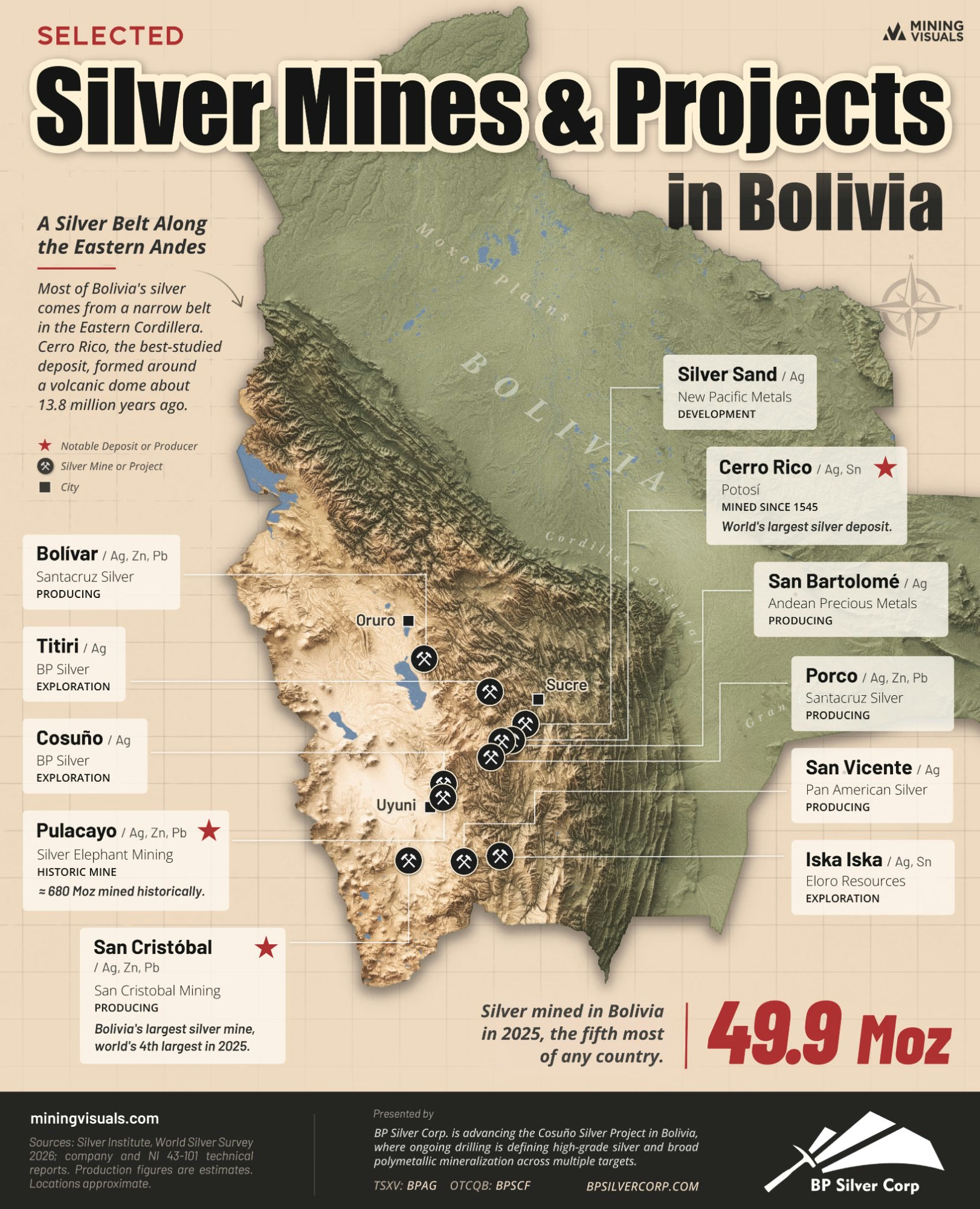

22,000 Tonnes in Reserve: The USGS estimates Bolivia’s silver reserves at 22,000 tonnes, about 3.6% of the world’s 610,000 tonnes.
678 Moz From Pulacayo: A 2020 technical report cites a state estimate of 678 Moz mined there before the mine closed in 1959.
Central Andean Geology: Bolivia shares the Central Andean metallogenic belt with Chile, Peru and Argentina, with similar geological features.
About 60% of Bolivia “has not been systematically explored,” according to government estimates cited in an April 2026 Harvard Growth Lab working paper. The same paper concludes that “Bolivia’s mineral potential is substantial.”
Silver shows both sides of that picture. Bolivia mined 49.9 million ounces (Moz) in 2025, up 4% on 2024, per the World Silver Survey 2026. The map above traces where that silver comes from, and where the search for more is under way: from a mountain mined since the 16th century to projects still drilling their first targets.
Bolivia “shares the Central Andean metallogenic belt with Chile, Peru, and Argentina,” the Harvard paper notes, with “similar geological features” to its two larger mining neighbors. The deposits on the map sit along that belt’s Bolivian stretch, in Potosí and Oruro.
The belt’s best-studied deposit shows how quickly such systems can form. A study in Mineralium Deposita dates Cerro Rico’s dacite dome to 13.8 million years ago and finds that mineralization followed within about 0.3 million years. How ore forms around volcanic centers like this one was covered in MiningVisuals’ porphyry and epithermal explainer.
The same study calls Cerro Rico “the world’s largest silver deposit,” mined for silver since the sixteenth century and for tin and zinc in the twentieth. About 18 km northeast of Uyuni, Pulacayo produced an estimated 678 Moz of silver, plus 200,000 tons each of zinc and lead, according to a state survey figure cited in a 2020 NI 43-101 technical report.
The report adds that Pulacayo reached 5.7 Moz in 1891, when it was the second-largest mining operation in Bolivia, and closed under state miner COMIBOL in 1959. At that historical estimate, its lifetime output equals roughly 38 years of production at San Cristóbal, the country’s largest silver mine today.
San Cristóbal ranks fourth among all silver mines in the World Silver Survey, at 17.6 Moz in 2025, and first among primary silver mines on the Metals Focus list, which counts only operations where silver is a defining product. Using the survey’s figures, it produced about 35% of Bolivia’s 2025 silver.
Production beyond it is concentrated too. Four operations (San Cristóbal, San Bartolomé, San Vicente and Sinchi Wayra) account for “roughly 85 percent” of private production, and zinc and silver make up 83% of private output, per the Harvard paper.
Bolivia “remains a top-10 producer of silver, tin, zinc and lead,” and its reserves recognized by the U.S. Geological Survey “have a gross in-situ value of roughly $75 billion at current prices,” Bloomberg reported in October. The Harvard paper adds a time frame: “Bolivia’s mining potential is real but it will require time for it to be developed.”
That time is spent moving projects up a defined ladder. Under the CIM Definition Standards, drilling first outlines a resource, and a reserve “must be demonstrated by a Pre-Feasibility Study or Feasibility Study.” Silver explorers in Potosí, including New Pacific Metals, Eloro Resources and BP Silver, are working at different rungs of that ladder.
On November 17, BP Silver reported assay results from the first two holes drilled at Jalsuri Northeast, a roughly 1 km east-west structural zone at its Cosuño project. Hole CO-0023 intersected 12 metres grading 441 g/t silver from 22 metres downhole, including 1 metre at 2,620 g/t, which the company says is the highest silver grade from drilling at Cosuño to date.
The company describes the mineralization as hosted in breccias along a faulted contact between volcanic rocks and older sedimentary basement. The reported intervals are core lengths, as true widths have not yet been determined, and Cosuño has not published a mineral resource.
BP Silver Corp. is a Canadian silver exploration company advancing its flagship Cosuño Silver Project in Bolivia’s prolific silver-polymetallic belt.
The ~3,375-hectare Cosuño Project hosts an extensive ~10.5 km² hydrothermal alteration footprint with multiple exploration targets and significant areas remaining untested. Drilling has returned high-grade silver mineralization at Pocañita Chica and broad polymetallic mineralization at Jalsuri North, approximately 3 km apart.
With Phase 2 drilling ongoing and additional assay results pending, BP Silver is advancing a systematic exploration program combining drilling, geological mapping, magnetic surveying and induced polarization to refine targets across the broader Cosuño system.
The Company is focused on defining the scale, continuity and discovery potential of Cosuño through an ongoing multi-phase exploration program.
Learn more about BP Silver Corp. at bpsilvercorp.com.


In 2025, technology used 324 tonnes of gold, according to the World Gold Council's Q3 2026 data tables. At 2025's average price of $3,432 an ounce, that was worth about $35.8 billion, a MiningVisuals calculation from the council's figures. Most of it sits in parts that are never seen: the contacts, boards and wires that carry signals inside phones, servers and satellites.
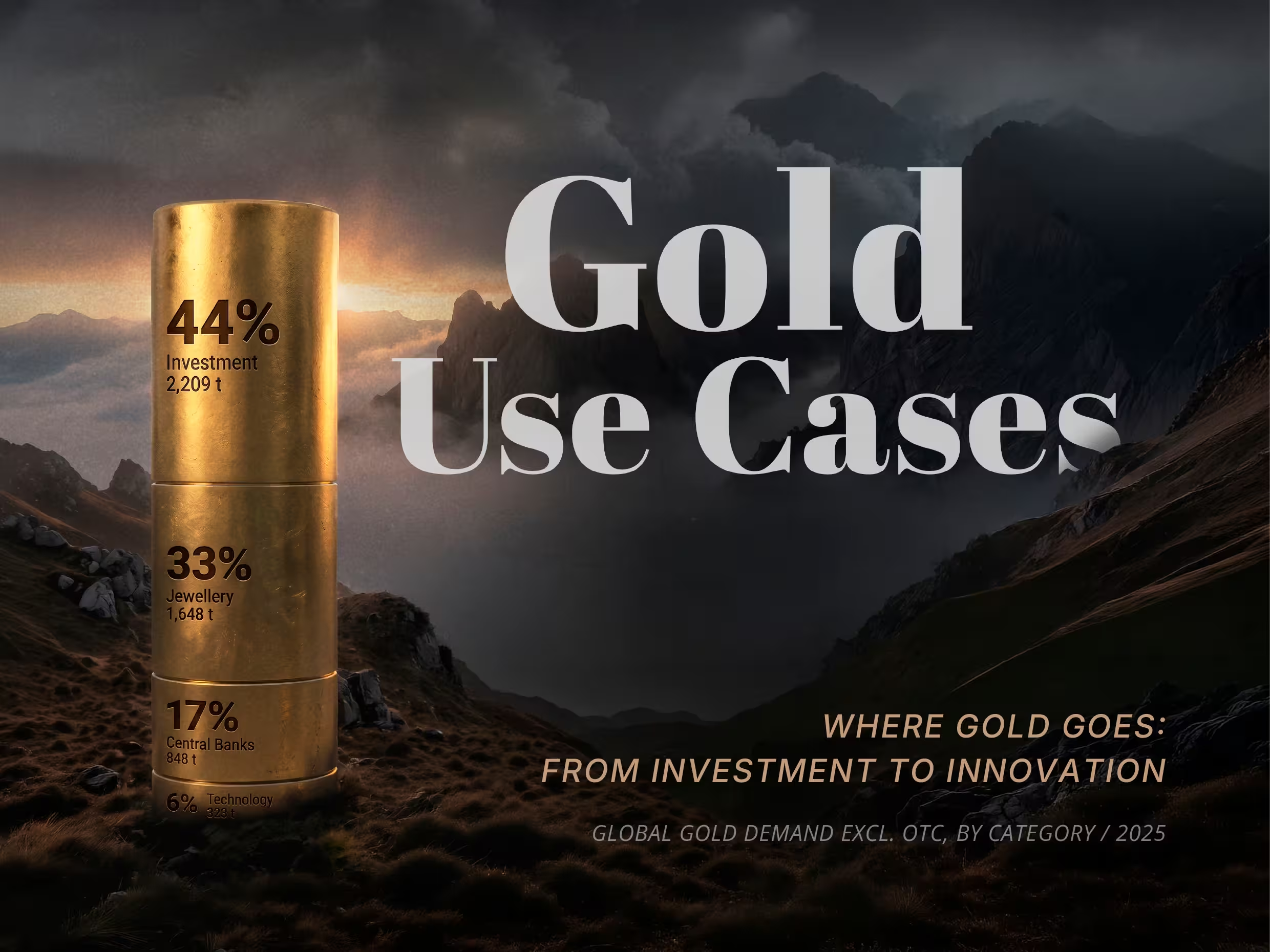
On June 16, 2026, the World Gold Council published its annual survey of central banks. A record 45% of the 76 respondents said they plan to increase their own gold holdings over the next 12 months, and 89% expect global central bank holdings to rise, according to the council. Central banks are one of four uses for the gold bought each year, and the balance between them has changed. In 2010, jewellery took 49% of demand and investment 39%, according to the council's data tables. In 2025, the order reversed: investment took 44% and jewellery 33%.

In 1934, the US government set the price of gold at $35 an ounce. In September 2026, the market price averaged $4,319. Measured in today's money, gold has done more than keep up with rising prices. An ounce is now worth almost five times what it was when the price was set in 1934, and more than at the famous 1980 peak. For the companies that mine it, that has meant record margins.

The largest silver producer among the world's primary silver mines in 2025 sat not in Mexico but in southwestern Bolivia. San Cristóbal, a large open-pit silver-zinc-lead mine run by Minera San Cristóbal, produced 17.6 million ounces of silver, narrowly ahead of Mexico's Juanicipio at the same rounded figure, in new Metals Focus data on the 20 largest primary silver mines. These are the operations where silver is a defining product rather than an incidental byproduct of lead, zinc and gold. The list runs from centuries-old mines in Mexico's silver belt to remote sites in the Andes, the Australian outback and the Alaskan wilderness. Eight of the 20 sit in Mexico, together about 44% of the total, while the rest are spread across the Americas, Asia, Africa and Australia.