Geology
Why the Rock Cycle Has No Fixed Order
METAMORPHIC ROCK CAN FORM FROM ANY OF THE THREE ROCK TYPES, INCLUDING ITSELF
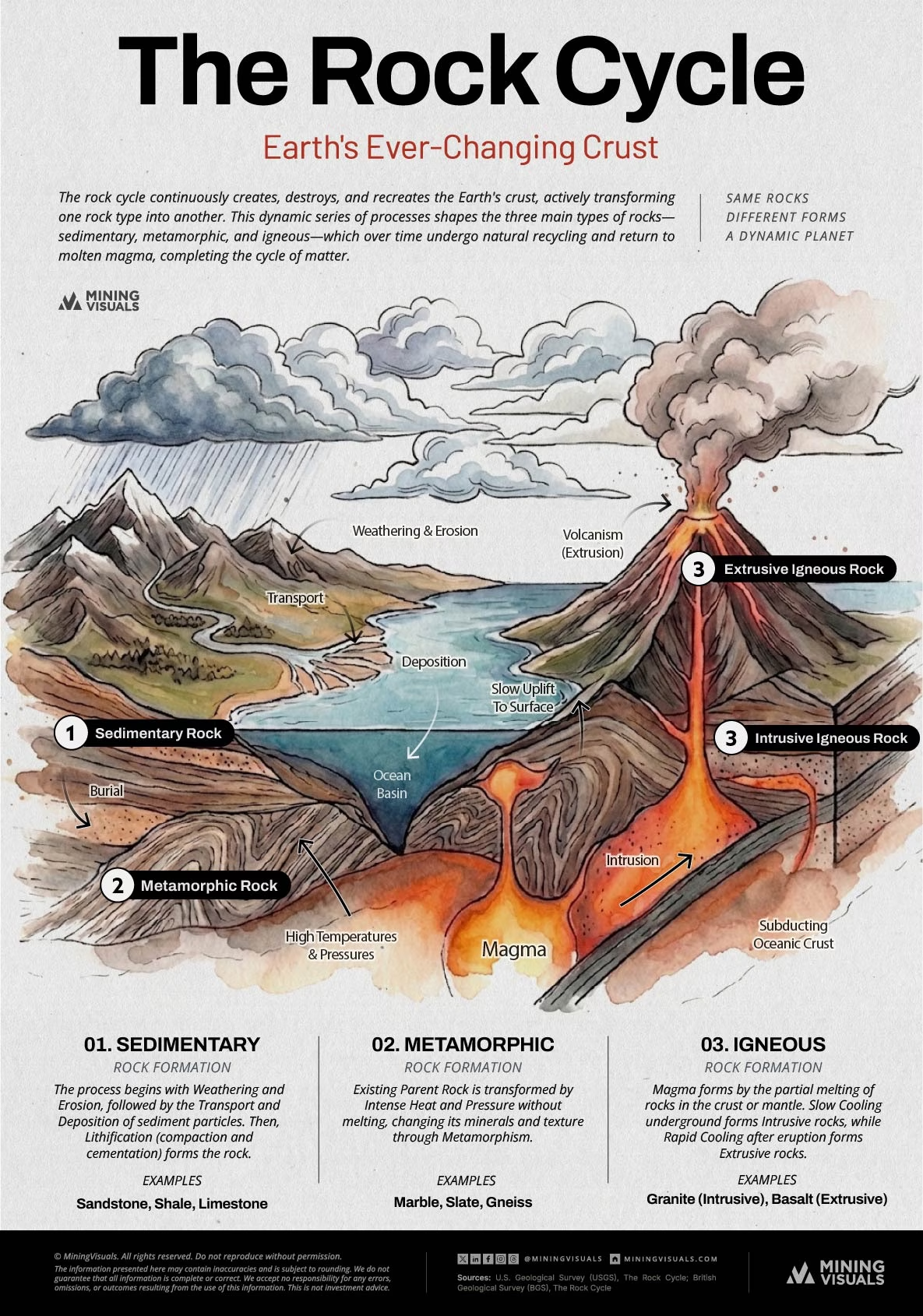

Heat Without Pressure: Intruding magma can bake nearby rock into metamorphic rock with no added pressure, called contact metamorphism.
Shells as Well as Sediment: Limestone can form from compressed shell fragments of sea creatures, not only from eroded rock.
Coal Counts as Rock: Dead plant material buried for millions of years becomes coal, a sedimentary rock, per the BGS.
On November 23, 2026, lava fountained for almost six hours from the north vent in Halemaʻumaʻu crater at the summit of Kīlauea, the USGS Hawaiian Volcano Observatory reported. It was episode 57 of an eruption that began on December 23, 2024, with fountains estimated at about 200 meters high.
Lava from the fountain spread across the eastern crater floor, where it is now hardening into new rock. This is the "Extrusive Igneous Rock" step of the infographic taking place now: lava at the surface cools quickly, according to the British Geological Survey. That new rock is the starting point for the three steps below, which follow it around the cycle and back to magma.
Weathering and erosion gradually break rock at the surface into sediment, the BGS explains: sand, pebbles and mud that rivers carry or wind blows off the land. This is the left side of the infographic, from the mountains down to the water.
Sediment is usually deposited in seas and lakes, in layers known as strata. Each new layer buries the ones beneath it, and over long periods the buried layers are compacted and cemented into sedimentary rock such as sandstone.
Sedimentary rock that is buried deeper, at a plate boundary for example, meets intense heat and pressure. Over millions of years these conditions change the rock physically, chemically or both, according to the BGS. Limestone becomes marble, and shale can become slate.
The rock stays solid while this happens. Metamorphism is change without melting, the USGS explains: rock that gets hot enough to melt becomes igneous instead. That is the dividing line between stage 2 and stage 3 of the graphic.
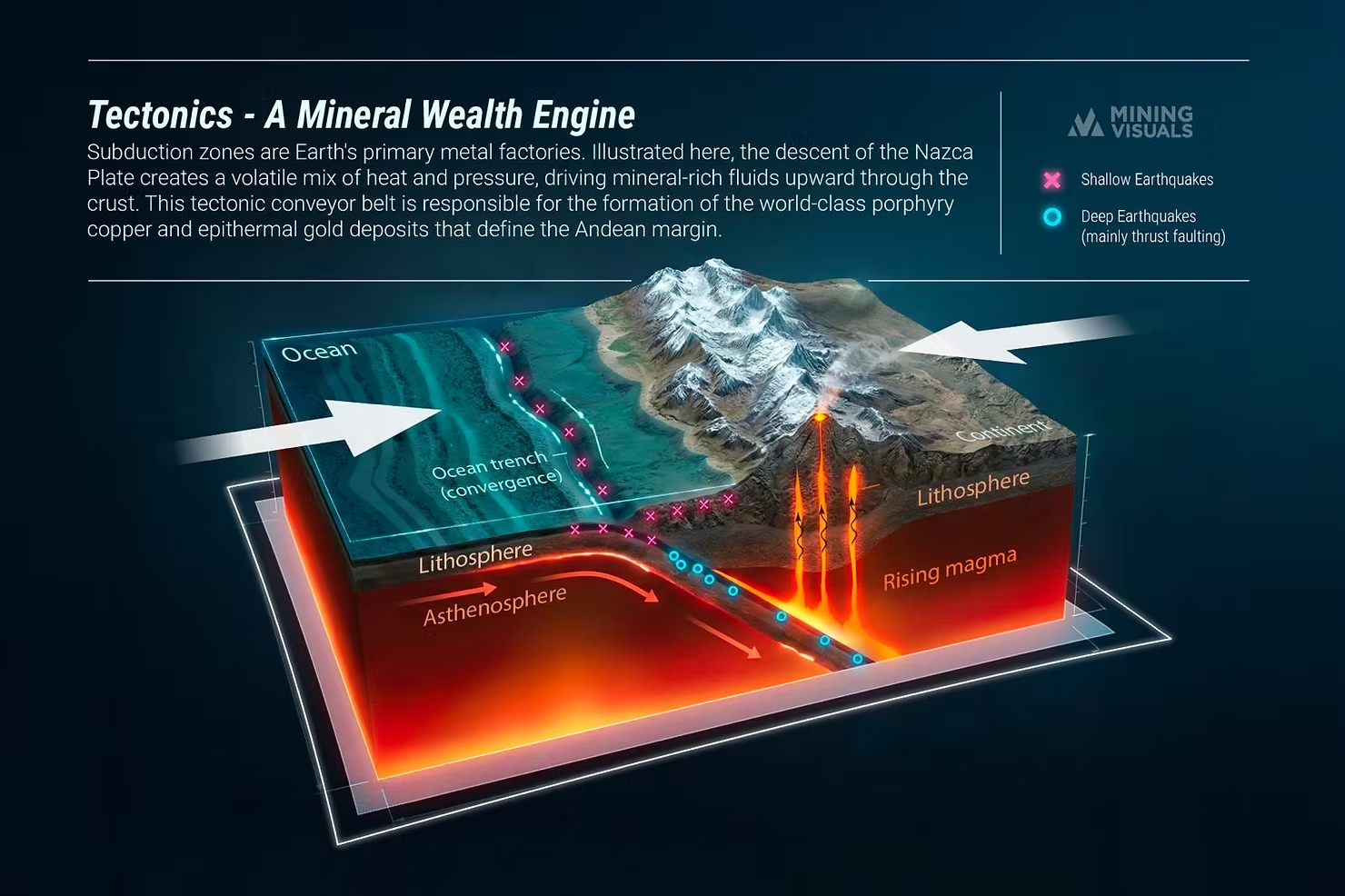
Rock that is heated far enough does melt. This happens deep inside the Earth at plate boundaries or hot spots, the BGS says, and the molten rock is called magma while underground and lava once it reaches the surface. Our January article on subduction zones explains one cause: water from a sinking plate lowers the melting point of the mantle above it.
Magma rises because it is hotter and lighter than the rock around it. If it stops underground, it cools into intrusive rock such as granite over thousands or millions of years. If it erupts, as at Kīlauea, it becomes extrusive rock at the surface, where weathering begins to work on it and the cycle starts again.
Metamorphic rocks start out as igneous, sedimentary or earlier metamorphic rock, according to the USGS, so the order above is the full route, not the only one. Granite is an example. Millions of years of uplift and erosion bring it to the surface, the BGS notes, where it can be broken into sediment and skip the metamorphic stage.

MiningVisuals Disclaimer: This article is for informational purposes only and does not constitute financial or investment advice. Always conduct your own research.

On November 6, 2025, the U.S. Interior Department added copper, silver and lead to its final critical minerals list, among 10 new entries. All three are main metals of a polymetallic deposit, where the USGS vein model places them in zones around a single intrusion. Silver shows how closely these metals are linked. The USGS says U.S. silver is "primarily obtained as a byproduct from lead-zinc, copper, and gold mines", and six smaller metals on the infographic reach the market the same way.
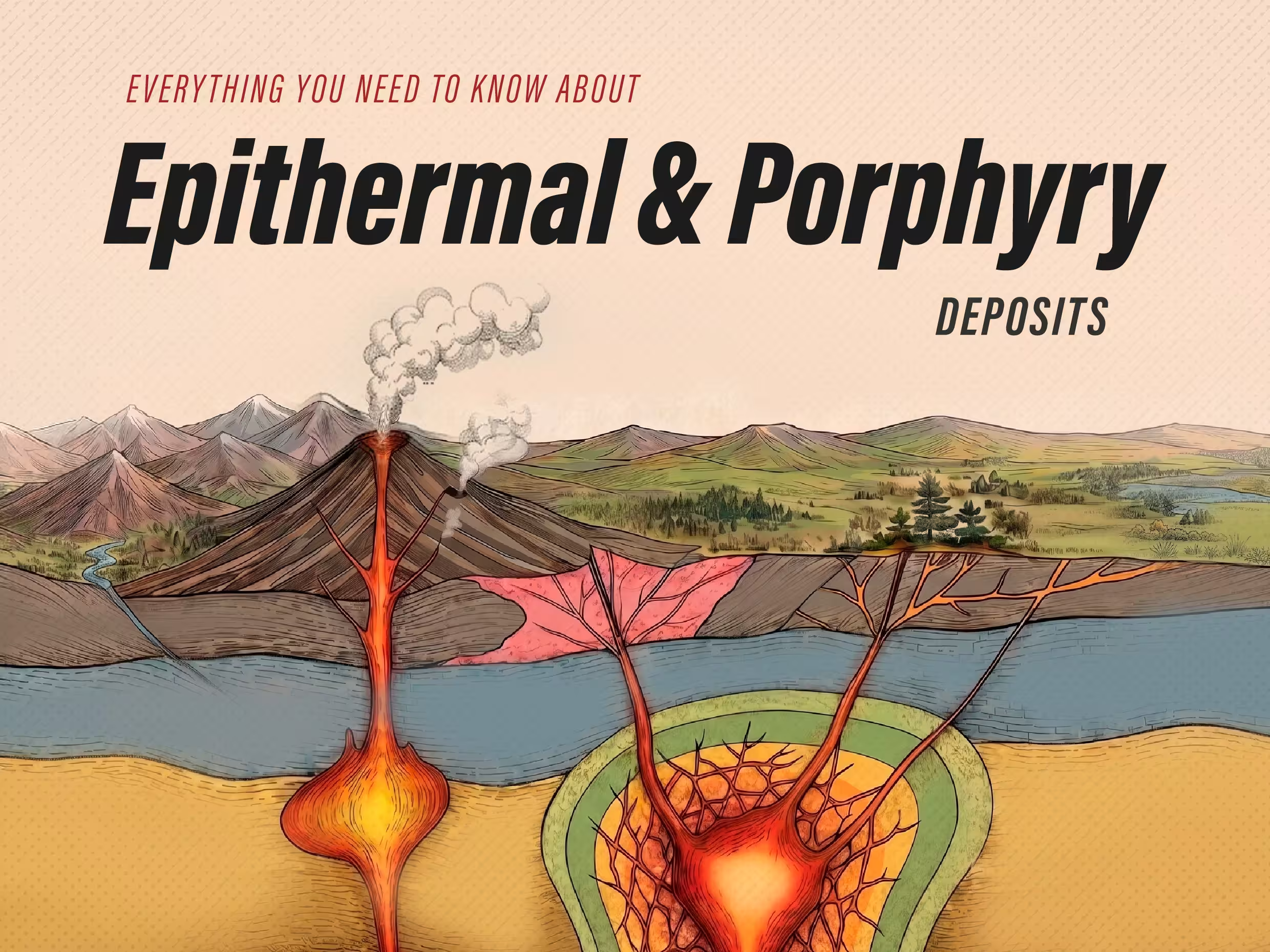
In March 2025, the USGS published an updated global database cataloguing every known porphyry copper deposit on Earth, a remarkable cartographic exercise for a deposit type that already supplies the planet with about 60% of its copper. What the database does not show is that the same magmatic engine produces a second, very different ore type immediately above: epithermal gold-silver veins

For over two centuries, diamond has sat unchallenged at the apex of mineral hardness. However, in early 2025, Chinese scientists successfully synthesized a hexagonal "super diamond" (lonsdaleite) that is theorized to withstand 58% more stress than standard cubic diamonds. While the frontier of material science pushes past natural limits, the foundational metric used to rank these materials remains surprisingly unchanged. Invented in 1812, the Mohs Scale of Mineral Hardness continues to be the ultimate benchmark for geologists, miners, and gemologists. Instead of complex chemical classifications, it relies on a simple, observable physical property: scratch resistance.