Geology
April 29, 2026
2 min
Geology
.webp)

Key takeaways
- A Timeless Field Tool: Created in 1812, the scale ranks minerals from 1 to 10 based on the principle that a harder substance can scratch a softer one.
- Exponentially Steeper at the Top: The scale is ordinal, not linear; the absolute hardness gap between sapphire (9) and diamond (10) is vastly greater than the gap between talc (1) and sapphire (9).
- Industrial and Gemological Benchmark: While subjective, the scale remains critical for field identification, industrial tool applications, and assessing jewelry durability.
For over two centuries, diamond has sat unchallenged at the apex of mineral hardness. However, in early 2025, Chinese scientists successfully synthesized a hexagonal "super diamond" (lonsdaleite) that is theorized to withstand 58% more stress than standard cubic diamonds. While the frontier of material science pushes past natural limits, the foundational metric used to rank these materials remains surprisingly unchanged. Invented in 1812, the Mohs Scale of Mineral Hardness continues to be the ultimate benchmark for geologists, miners, and gemologists. Instead of complex chemical classifications, it relies on a simple, observable physical property: scratch resistance. From identifying potential deposits in the field to understanding wear on industrial drill bits, this 200-year-old ordinal scale bridges amateur curiosity with professional mineralogy.
The Origins of Scratch Testing
In 1812, while working as a professor and curator in Graz, Austria, German mineralogist Friedrich Mohs sought a practical field method to identify minerals. Frustrated by the inconsistent chemical classifications of his time, Mohs turned to observable physical properties. He established a framework using ten readily available reference minerals, ranking them by their ability to scratch one another. More than 200 years later, this field framework remains largely unchanged.
The Ten Reference Minerals
The standard Mohs scale spans from the softest minerals to the hardest natural materials:
- Talc: Extremely soft; easily powdered and forms the base of baby powder.
- Gypsum: Soft enough to be scratched by a fingernail (roughly 2.2).
- Calcite: Scratched by a copper coin or penny.
- Fluorite: Scratched by a knife blade but can scratch calcite.
- Apatite: Scratched with difficulty by a steel knife (roughly 5.2).
- Orthoclase (Feldspar): Scratches glass with effort.
- Quartz: A key component of sand; scratches glass easily.
- Topaz: Harder than most everyday materials.
- Corundum: Includes ruby and sapphire; used heavily in industrial abrasives.
- Diamond: The hardest known natural mineral; nothing on the scale scratches it except another diamond.
The Non-Linear Reality of Hardness
A common misconception is that the Mohs scale represents a steady, quantitative increase in hardness. In reality, it is strictly an ordinal ranking system.
The gaps between the reference levels grow dramatically at the higher end of the scale. In absolute terms (measured by quantitative tests like the Vickers scale), a diamond is roughly four times harder than corundum. Consequently, the difference in absolute hardness between a sapphire (9) and a diamond (10) actually exceeds the entire cumulative difference between talc (1) and sapphire (9).
Practical Applications and Limitations
Despite lacking the precision of industrial measurements like Vickers, Brinell, or Rockwell, the Mohs scale’s simplicity guarantees its continued use. It remains a standard for the field identification of minerals and rocks, relied upon widely by institutions like the U.S. National Park Service.
It is also an essential metric in gemology. The scale is used to assess the durability and scratch resistance of jewelry stones; sapphires and rubies (9) are highly durable, whereas softer gems like emeralds require more protective care. However, because it is qualitative, results can vary based on a mineral's crystal direction or sample texture, limiting its use in precise metallurgy or alloy engineering.
Enduring Relevance in the Field
The Mohs scale exemplifies how a straightforward concept can establish a lasting scientific framework. Whether a retail investor is evaluating the geological reports of a hard-rock mining junior, or a gemologist is assessing the wear on a gemstone, Friedrich Mohs’s scratch test continues to be the definitive starting point for understanding mineral durability.
MiningVisuals Disclaimer: This article is for informational purposes only and does not constitute financial or investment advice. Always conduct your own research. Sources: Sarajevo Times, Science History Institute, Britannica, U.S. National Park Service, GIA




Explore More
View All

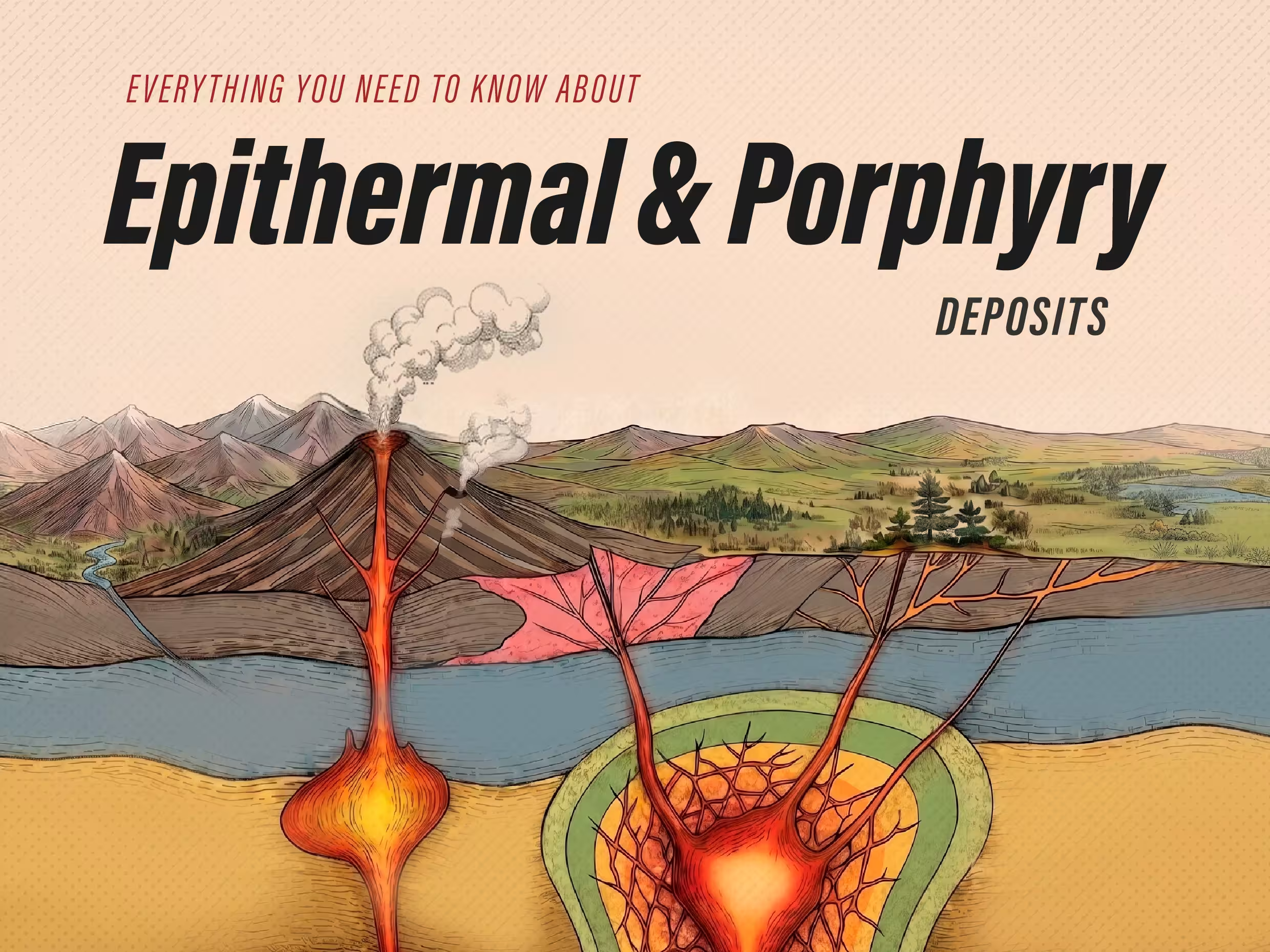
Inside Porphyry and Epithermal Deposits: The Geology of Earth's Most Productive Mines
Inside Porphyry and Epithermal Deposits: The Geology of Earth's Most Productive Mines
In March 2025, the USGS published an updated global database cataloguing every known porphyry copper deposit on Earth, a remarkable cartographic exercise for a deposit type that already supplies the planet with about 60% of its copper. What the database does not show is that the same magmatic engine produces a second, very different ore type immediately above: epithermal gold-silver veins

Properties of Common Minerals
Properties of Common Minerals
Minerals are the fundamental building blocks of rocks, forming the foundation of our planet and providing essential resources. From the humble Graphite in a pencil to sparkling Garnets in jewelry, minerals vary widely. But how do we tell these natural treasures apart?