Precious Metals
Three Ancient Belts Carry Ghana's Gold, and Investment Keeps Flowing to Them
ALMOST ALL OF GHANA'S GOLD HIDES ALONG A FEW ANCIENT FAULTS, AND THE MONEY KNOWS WHERE.
The following content is sponsored by Galiano Gold
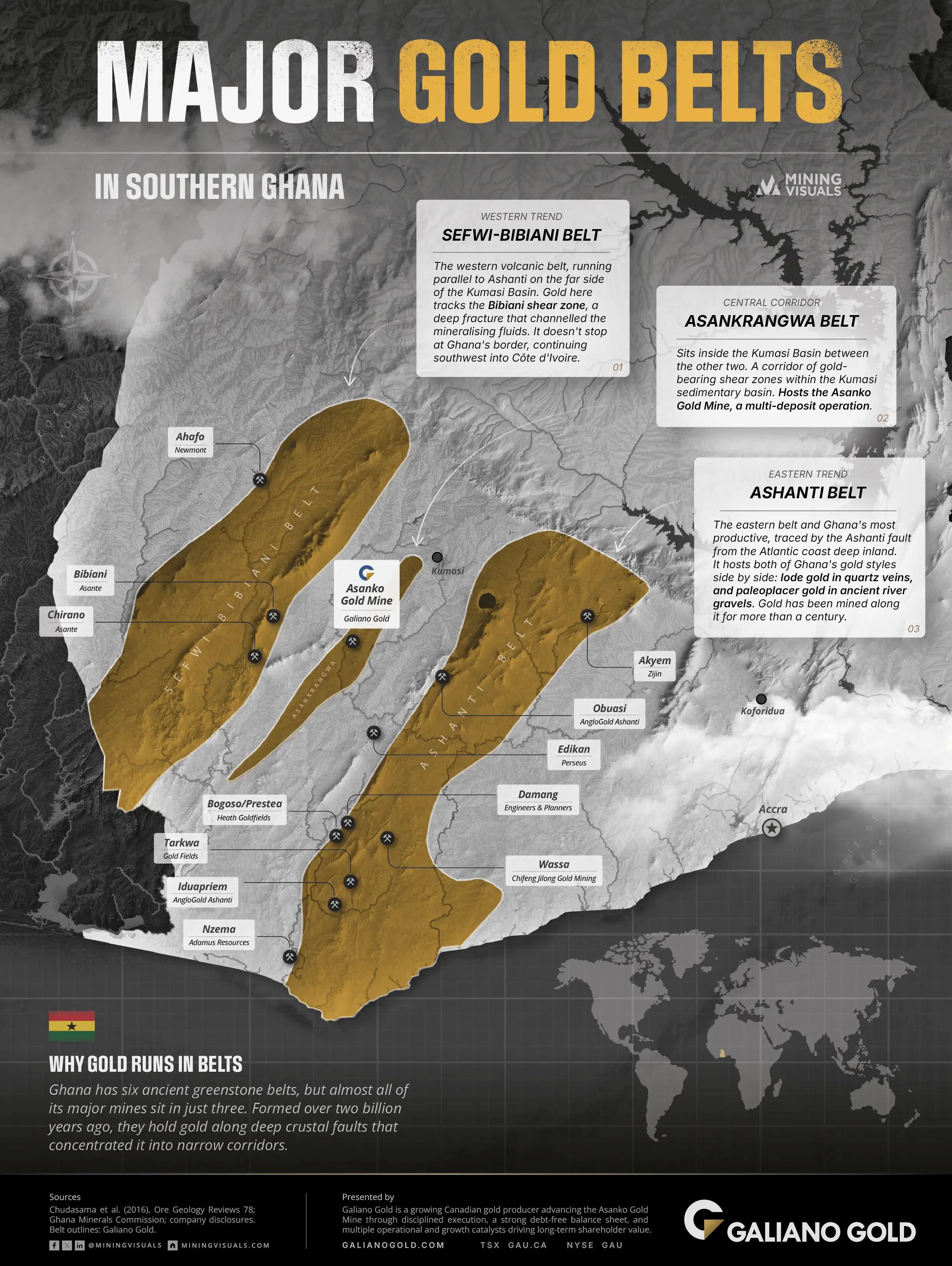

In March 2026, one of Ghana's own mining companies said it would invest about $1.2 billion in its operations at the Tarkwa and Damang gold mines. Both sit on the Ashanti belt, one of three narrow bands of ancient rock that carry almost all of Ghana's gold. Those belts, mapped above, are the reason the country's mines cluster where they do. More than a century after large-scale mining began, they are still drawing fresh capital, from Ghanaian and international investors alike.
Ghana's gold is not spread evenly across the country. It runs in belts, long narrow bands of ancient rock, and within them it clusters along deep fractures in the crust called shear zones. Billions of years ago, hot mineral-rich fluids rose up through these shear zones and faults in Ghana's Birimian rock and left gold behind as they cooled. Because the fluids followed the same great faults, so does the gold, tracing lines that run from the southwest to the northeast, the very lines geologists still follow to explore today.
How tightly the gold clusters is striking. A detailed geological study of the Kumasi Basin, the broad stretch of ground between the Ashanti and Sefwi-Bibiani belts, found that roughly 99% of its known gold occurrences sit within ground making up less than a third of the area. That is why Ghana's mines line up along the belts rather than scattering at random, and why the country's two very different deposit types, lode gold in quartz veins and Tarkwaian gold in ancient river gravels, still appear along the same trends.
The three belts are not the same kind of thing. Ashanti and Sefwi-Bibiani are volcanic belts, built from ancient lava and ash that hardened more than two billion years ago. The middle one, Asankrangwa, is different in kind: rather than a belt of volcanic rock, it is a line of gold-bearing fractures running down the centre of the basin between the other two.
That difference helps explain why it was the last of the three to be understood. Where the older belts reach the surface, much of the Asankrangwa ground lies buried under younger river sediments and soil, a cover that kept it out of view for early prospectors. For a long time it was worked mainly by small-scale and colonial-era miners, and its gold-bearing structure was, per the same study, not fully recognised until the mid-1990s, generations after mining had taken hold on its neighbours.
It is the belt that hosts Galiano Gold's Asanko mine, sitting between the two older and better-known trends.
More than a century of mining has not exhausted the interest in these belts. In March 2026, Engineers & Planners, a wholly Ghanaian-owned mining company, said it would invest about $1.2 billion in its operations at Tarkwa and Damang, two long-running mines on the Ashanti belt, backed by a fleet of new heavy mining equipment. International capital is moving too: in 2025, Zijin Mining completed a $1 billion acquisition of the Akyem mine in Ghana's Eastern Region. The rock was set two billion years ago; the money committed to working it is being put down this year.

Galiano Gold Inc. (TSX: GAU) (NYSE American: GAU) is building momentum at the Asanko Gold Mine in Ghana, West Africa. With a strong, debt-free balance sheet, disciplined execution, and multiple operational and growth catalysts ahead, Galiano is focused on strengthening cash flow generation, growing Mineral Resources and Mineral Reserves, extending mine life, and delivering long-term shareholder value.
As a Canadian gold producer, Galiano is committed to responsible mining and sustainable value creation while contributing to Ghana's economic development through local employment, procurement, and community investment.
Learn more at www.galianogold.com.
MiningVisuals Disclaimer: This article is for informational purposes only and does not constitute financial or investment advice. Always conduct your own research.
Sources: Chudasama et al. (2016), Ore Geology Reviews 78 (Kumasi Basin geology, belt structure); International Mining (Engineers & Planners investment at Tarkwa and Damang); Citinewsroom (Zijin–Newmont Akyem acquisition); MiningVisuals (prior articles, for continuity).


The largest silver producer among the world's primary silver mines in 2025 sat not in Mexico but in southwestern Bolivia. San Cristóbal, a large open-pit silver-zinc-lead mine run by Minera San Cristóbal, produced 17.6 million ounces of silver, narrowly ahead of Mexico's Juanicipio at the same rounded figure, in new Metals Focus data on the 20 largest primary silver mines. These are the operations where silver is a defining product rather than an incidental byproduct of lead, zinc and gold. The list runs from centuries-old mines in Mexico's silver belt to remote sites in the Andes, the Australian outback and the Alaskan wilderness. Eight of the 20 sit in Mexico, together about 44% of the total, while the rest are spread across the Americas, Asia, Africa and Australia.
Central banks bought more gold between April and June 2026 than in any second quarter on record, according to a World Gold Council report published on July 30. That keeps them net buyers this year, as they have been every year since 2010. Underneath, the picture is changing. Russia and Türkiye, both big buyers in the past, have been selling.

The nine West African countries with significant reported output produced about 15% of the world's mined gold in 2025, according to Metals Focus and World Gold Council data. Almost every mine on the map above was built in the past 25 years, and four more reached production in the last eighteen months: Lafigué in Côte d'Ivoire in June 2024, Kiaka in Burkina Faso in June 2025, Ahafo North in Ghana in October 2025 and Kiniero in Guinea in December 2025.
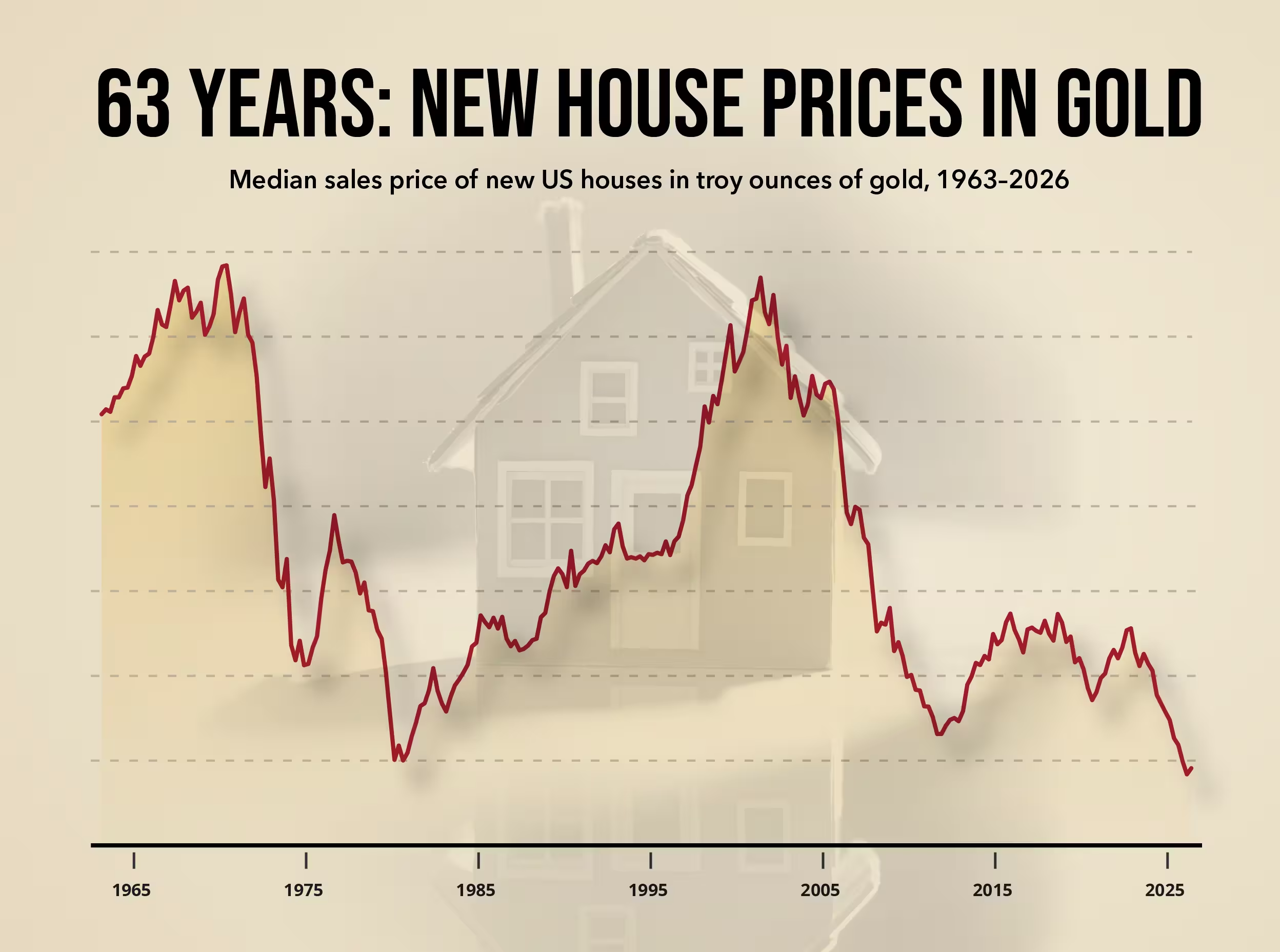
The US Census Bureau's July new-home report, released on August 25, put the median price of a newly built house at $393,800. HousingWire noted that was the lowest since July 2021. In dollars, the market has moved within a narrow band: the quarterly median has stayed between $408,500 and $435,400 since 2023.