Precious Metals
March 5, 2026
3 min
Precious Metals

Key takeaways
Key Takeaways
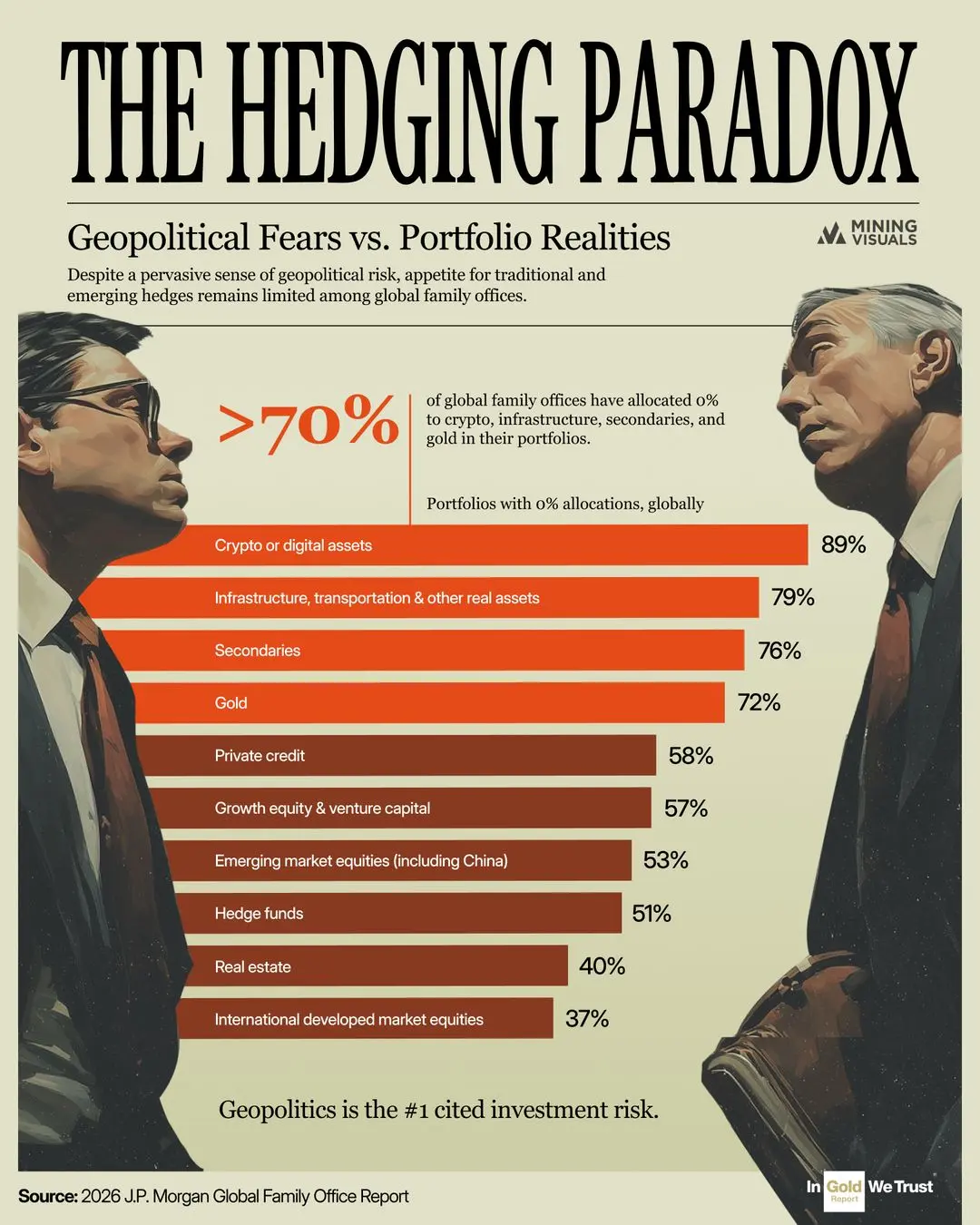
- Geopolitics is the Top Risk, but Hedges are Ignored: One in five global family offices identify geopolitics as their number one investment risk. However, despite these fears, 72% of these offices have zero exposure to traditional safe havens like gold.
- AI Ambitions Lack an Infrastructure Foundation: While 65% of family offices plan to prioritize artificial intelligence investments, 79% have zero allocation to the physical infrastructure required to power it.
- Crypto Remains Sidelined Despite Hype: Despite the headlines surrounding digital assets, a massive 89% of family offices remain on the sidelines and have no exposure to cryptocurrencies in their portfolios.
The geopolitical temperature is boiling. Between shifting global alliances, fractured supply chains, and persistent structural inflation, macro uncertainty is the defining feature of 2026. According to the newly released J.P. Morgan Private Bank 2026 Global Family Office Report—which gathered insights from 333 family offices—geopolitics is overwhelmingly cited as the number one risk to portfolio performance.
Yet, a glaring contradiction has emerged. While we have already established the profound structural deficits and safe-haven demand driving the recent silver breakout, the world's wealthiest families are surprisingly under-allocated in traditional and alternative hedges. Instead of flocking to hard assets, a staggering majority are sitting on the sidelines, completely ignoring gold, infrastructure, and digital assets. This disconnect between stated fears and actual capital deployment is what we call "The Hedging Paradox."
The #1 Risk Nobody is Hedging
According to the 2026 J.P. Morgan Global Family Office Report, which surveyed 333 single family offices overseeing an average of $1.16 billion in assets, geopolitics and trade policy dominate the macro risk landscape. For international offices, the anxiety is even more pronounced, with 74% ranking geopolitics among their top five concerns.
However, when looking under the hood of these billion-dollar portfolios, defensive posturing is remarkably absent. Traditional safe havens like gold are entirely absent from 72% of family office portfolios. Even among those who do invest, the average global allocation to gold is a microscopic 0.9%.
The AI Disconnect: Software over Hardware
The promise of artificial intelligence is a dominant investment theme, with 65% of family offices globally prioritizing AI. Yet, the capital is flowing almost exclusively into the application and software layers, ignoring the massive physical footprint required to sustain the technology.
An astonishing 79% of family offices have zero allocation to infrastructure, transportation, and other real assets. This represents a critical blind spot. Infrastructure is the physical backbone of the AI revolution, providing the immense power generation, connectivity, and logistics required for data centers. By completely avoiding real assets, these portfolios are exposed to the upside of AI software, but remain highly vulnerable to the inflation and physical supply constraints of the hardware reality.
Institutional Convergence and the Crypto Snub
Family offices are increasingly managing their capital like major institutional investors, heavily favoring growth-oriented risk assets. On average, public equities (38.4%) and private investments (30.8%) account for over two-thirds of portfolio allocations.
When these ultra-wealthy investors do seek alternatives, they lean heavily toward drawdown private equity funds and real estate. Meanwhile, emerging hedges are left in the dust. A massive 89% of family offices have no exposure to crypto or digital assets. This signals that despite mainstream hype, the smartest money in the room is still not convinced that cryptocurrencies belong in a generational wealth-preservation strategy.
The data reveals a fascinating behavioral gap in the ultra-wealthy demographic. Family offices correctly identify the shifting, fragmented global order and volatile inflation as their primary threats. Yet, their portfolios reflect an era of seamless globalization that has arguably already ended. As the geopolitical landscape continues to fracture, this "Hedging Paradox" suggests that when family offices finally decide to align their portfolios with their stated fears, the ensuing capital rotation into gold, infrastructure, and real assets could be significant.
Disclaimer & Sources
Disclaimer: The content provided on MiningVisuals is for educational and informational purposes only and does not constitute financial or investment advice. Always conduct your own due diligence and consult with a licensed financial advisor before making any investment decisions. Past performance is not indicative of future results.
Sources: J.P. Morgan Private Bank 2026 Global Family Office Report, Visual Capitalist.




Explore More
View All


The World's 20 Largest Primary Silver Mines by 2025 Output
The World's 20 Largest Primary Silver Mines by 2025 Output
The largest silver producer among the world's primary silver mines in 2025 sat not in Mexico but in southwestern Bolivia. San Cristóbal, a large open-pit silver-zinc-lead mine run by Minera San Cristóbal, produced 17.6 million ounces of silver, narrowly ahead of Mexico's Juanicipio at the same rounded figure, in new Metals Focus data on the 20 largest primary silver mines. These are the operations where silver is a defining product rather than an incidental byproduct of lead, zinc and gold. The list runs from centuries-old mines in Mexico's silver belt to remote sites in the Andes, the Australian outback and the Alaskan wilderness. Eight of the 20 sit in Mexico, together about 44% of the total, while the rest are spread across the Americas, Asia, Africa and Australia.

Central Banks Have Been Net Gold Buyers Since 2010, After Two Decades of Net Selling
Central Banks Have Been Net Gold Buyers Since 2010, After Two Decades of Net Selling
Central banks bought more gold between April and June 2026 than in any second quarter on record, according to a World Gold Council report published on July 30. That keeps them net buyers this year, as they have been every year since 2010. Underneath, the picture is changing. Russia and Türkiye, both big buyers in the past, have been selling.

Gold Mines in West Africa: Two Billion Years in the Making
Gold Mines in West Africa: Two Billion Years in the Making
The nine West African countries with significant reported output produced about 15% of the world's mined gold in 2025, according to Metals Focus and World Gold Council data. Almost every mine on the map above was built in the past 25 years, and four more reached production in the last eighteen months: Lafigué in Côte d'Ivoire in June 2024, Kiaka in Burkina Faso in June 2025, Ahafo North in Ghana in October 2025 and Kiniero in Guinea in December 2025.
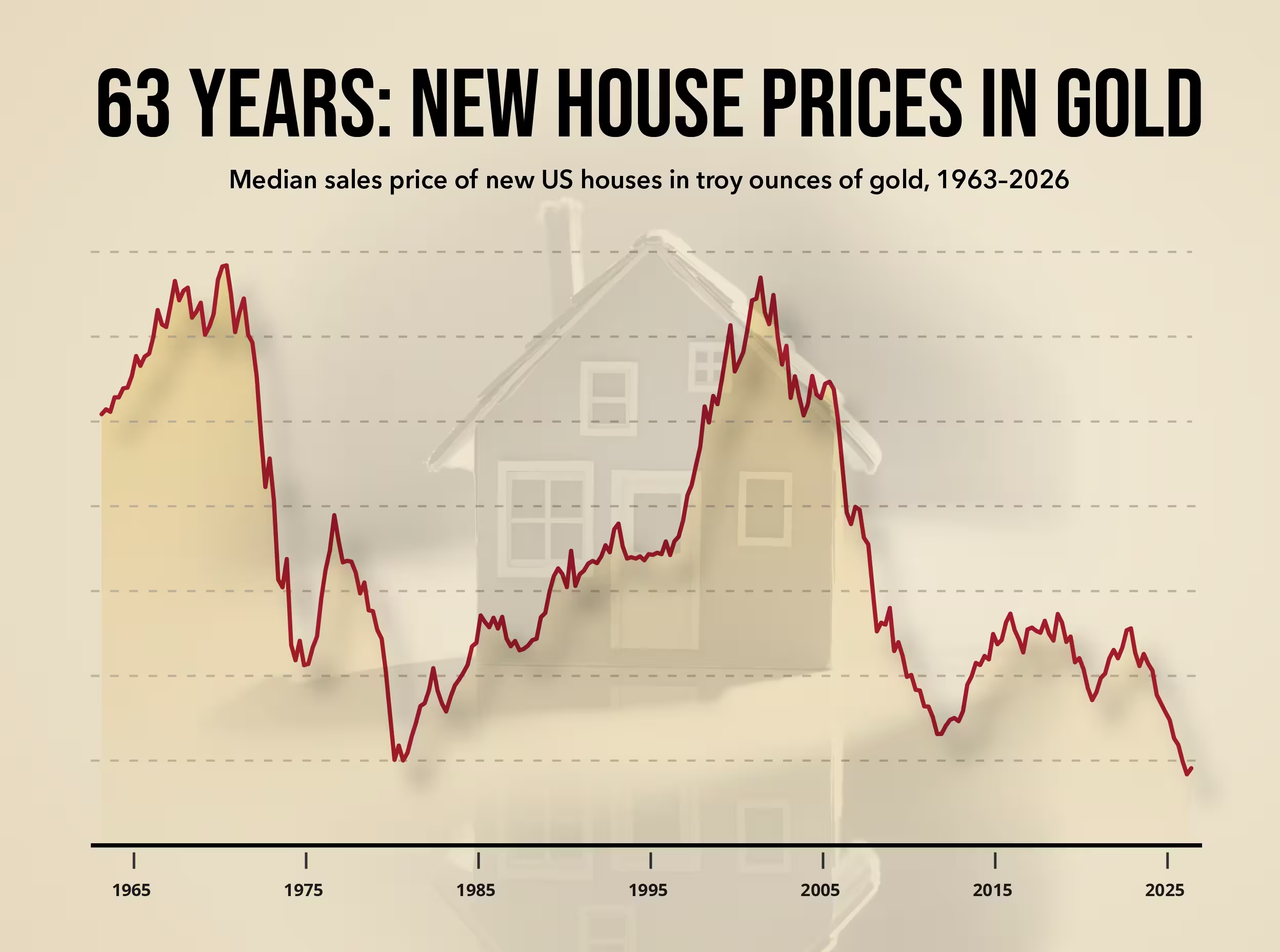
A Median New US Home Now Costs Less Than 100 Ounces of Gold
A Median New US Home Now Costs Less Than 100 Ounces of Gold
The US Census Bureau's July new-home report, released on August 25, put the median price of a newly built house at $393,800. HousingWire noted that was the lowest since July 2021. In dollars, the market has moved within a narrow band: the quarterly median has stayed between $408,500 and $435,400 since 2023.