Commodities
The Age of Giants: How Mining Shovels Grew, Peaked, and Deliberately Shrank
THE LARGEST DIGGING MACHINE EVER BUILT NEEDED A CREW OF FOUR, AND THE INDUSTRY SHRANK ON PURPOSE.
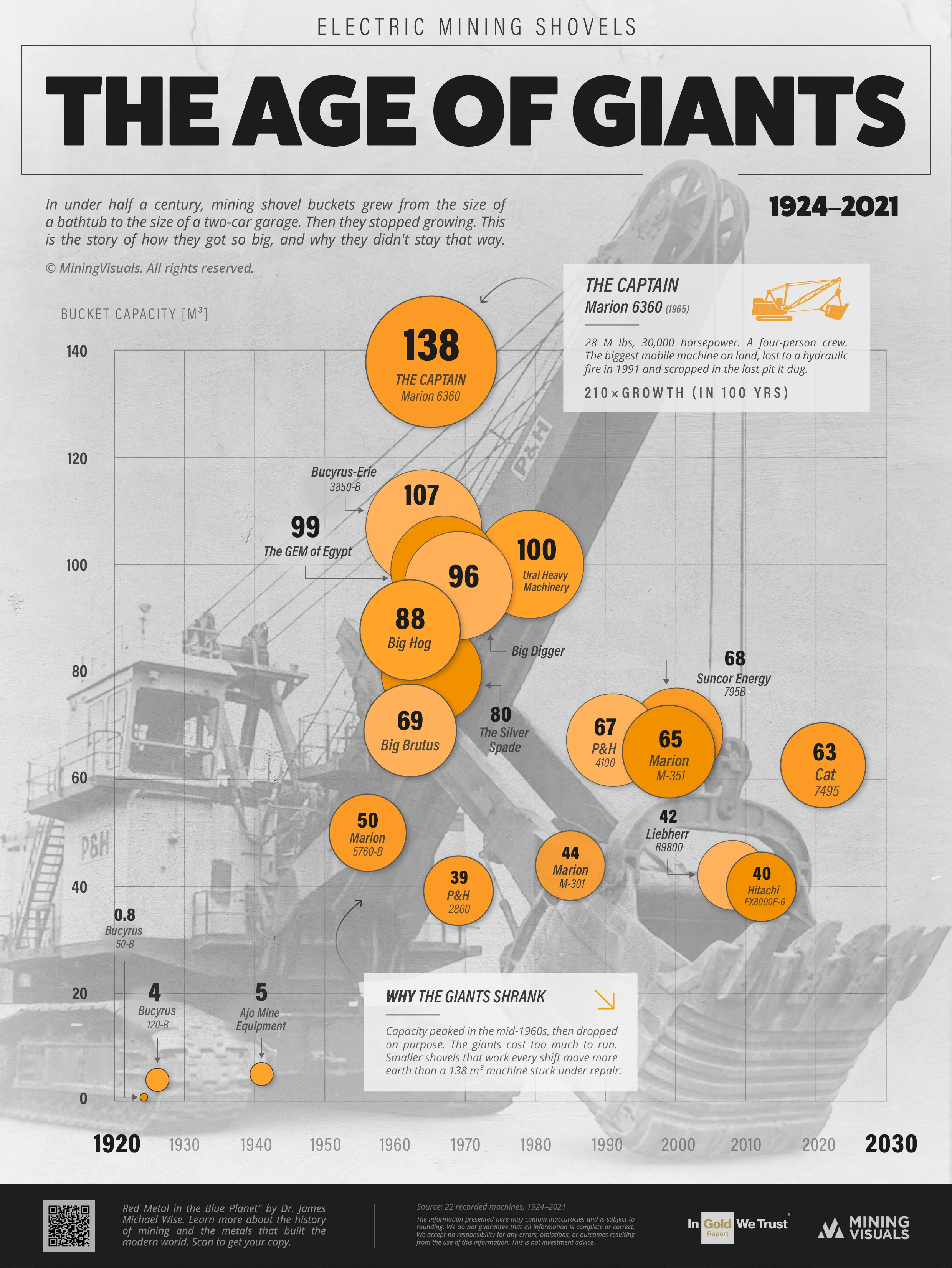

A Crew of Four Ran the Biggest: The Captain was the heaviest land vehicle ever built, yet a four-person team operated its 138 m³ dipper.
The Peak Was 1965, Not Later: Bucket size culminated with the Marion 6360's 180-cubic-yard dipper; nothing bigger followed, marking the ceiling of the shovel era.
The Giants Still Work, Smaller: Modern mines like Wyoming's Black Thunder run P&H 2800 electric shovels, a fraction of the Captain's size, around the clock.
This graphic draws on data compiled by Dr. James Michael Wise in Red Metal in the Blue Planet, a history of copper mining and the metals that built the modern world. Figures have been independently verified against primary sources.
For four decades, the American coalfields hosted an engineering arms race measured in cubic metres of bucket. It ended not with a bigger machine, but with a deliberate retreat. The single largest mobile land machine ever built, the Marion 6360 "Captain," was commissioned in 1965 and destroyed by fire in 1991. No shovel has approached its scale since, and the machines that replaced it were smaller by design. The chart above tracks 22 shovels from 1924 to 2021; the story underneath it is why the curve rises, spikes, and then settles.
The class of machine in the chart barely existed in 1924. The first crawler-mounted stripping shovel, the Bucyrus 80-B, arrived in 1922 with a 2.5-cubic-yard bucket, tiny by later standards but free of the rail tracks that pinned earlier shovels in place. That mobility is what let the machines grow. The real leap came in the 1950s, when surging demand for coal to feed electric utilities made large-scale overburden removal worth the capital. The Marion 5760 "Mountaineer," erected in 1955-56, was the world's first giant stripping shovel, and it opened a decade of record-breaking that the graphic's steep 1956-to-1965 climb captures directly.
The chart's cluster near 80 to 100 m³ hides a detail worth pulling out: several of these were near-identical machines built to different specs. The Silver Spade and the GEM of Egypt were both Bucyrus-Erie 1950-B shovels, but they were not the same size. The GEM carried a 130-cubic-yard (99.4 m³) bucket while the Spade held 105 cubic yards (80 m³). That 20 percent gap between sister machines shows how bespoke these builds were; each was engineered for a specific mine's overburden depth and reach, not mass-produced to a standard. It is why a single model number can appear twice on the chart at two different capacities.
The Captain marked the end of the climb rather than a waypoint. Its dipper moved 270 tons of rock in a single pass, but machines at that scale were single-purpose and immobile once sited. Two forces ended the era. Deeper coal seams favoured the longer reach of walking draglines, which cast overburden directly into the mined-out pit; Bucyrus-Erie's own 4250-W "Big Muskie," a 1969 dragline, swung a 220-cubic-yard bucket far larger than any shovel. And economics turned against the behemoths. Big Brutus, the largest electric shovel still standing, was shut down in 1974 as uneconomical. The chart's modern plateau is not a technical limit. It is a choice.
The most useful thing the graphic understates is that the small end of its modern cluster is still digging. Wyoming's Black Thunder mine, in the Powder River Basin that reshaped American coal after the 1970s, runs a fleet of five P&H 2800 electric mining shovels and a Marion 351-M, machines that sit in the 40-to-70 m³ band on the chart. A right-sized shovel that runs continuously and moves between mines outproduces, over its service life, a 138 m³ giant that spends its days under repair and cannot be relocated. The Captain won the record. The machines that replaced it won the argument.
MiningVisuals Disclaimer: This article is for informational purposes only and does not constitute financial or investment advice. Always conduct your own research.
The dataset behind this graphic was compiled by Dr. James Michael Wise, first published in Red Metal in the Blue Planet. Figures shown here have been independently verified and corrected against primary sources.
Sources: Marion 6360 (Wikipedia); Marion Power Shovel Company (Wikipedia); Power shovel (Wikipedia); The Silver Spade (Wikipedia); Bucyrus-Erie (Wikipedia); Coal Age; Classic Construction Models; Historical Construction Equipment Association via Issuu; ASME; Mining-Technology.

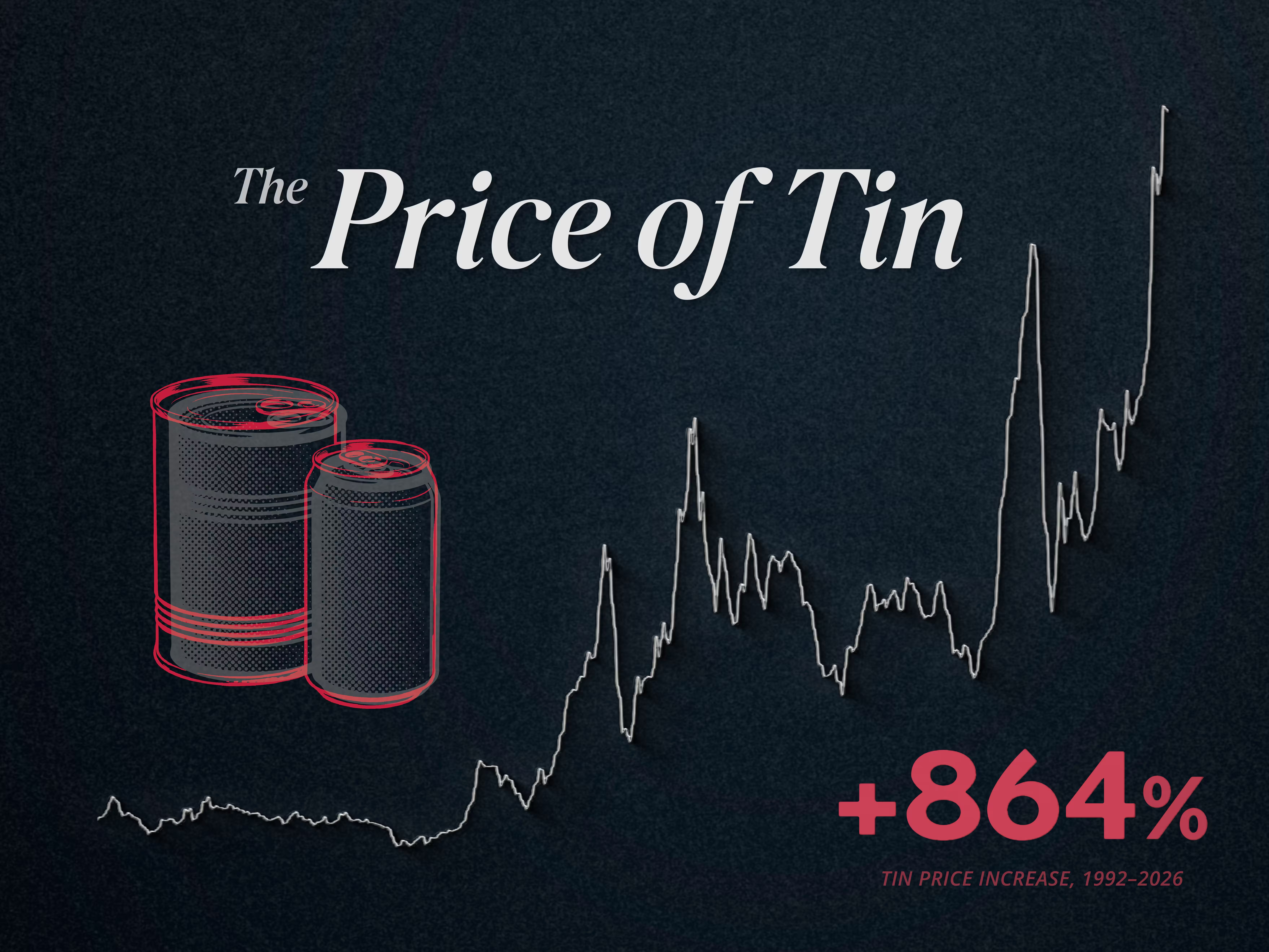
In January 2026, the London Metal Exchange three-month tin contract closed at US$53,462 a tonne, a nominal all-time high that surpassed the March 2022 peak, and it has traded near those levels since. The puzzle is that there is no shortage of tin today: exchange inventories actually rose as the price climbed, rather than being drawn down. Two very different things are holding the price up. The first is short-term: a wave of investor buying, which the industry says drove the January jump. The second is long-term: on current forecasts, the world will not mine enough tin to meet demand later this decade, a gap already projected before the rally began and expected to persist after it fades. The lasting story is that forecast shortfall, not the spike.

Indium is one of the metals you never see but use constantly. As indium tin oxide, it forms the transparent conductive coating on nearly every LCD and touchscreen, and that single application still accounts for most global consumption, according to the USGS. But the metal's role is broadening. Its compounds now sit inside the high-speed optical chips that route data through AI data centers, a shift that has turned a quiet, display-driven material into one buyers watch closely, especially as China refines about 70% of it and has begun tightening the flow.
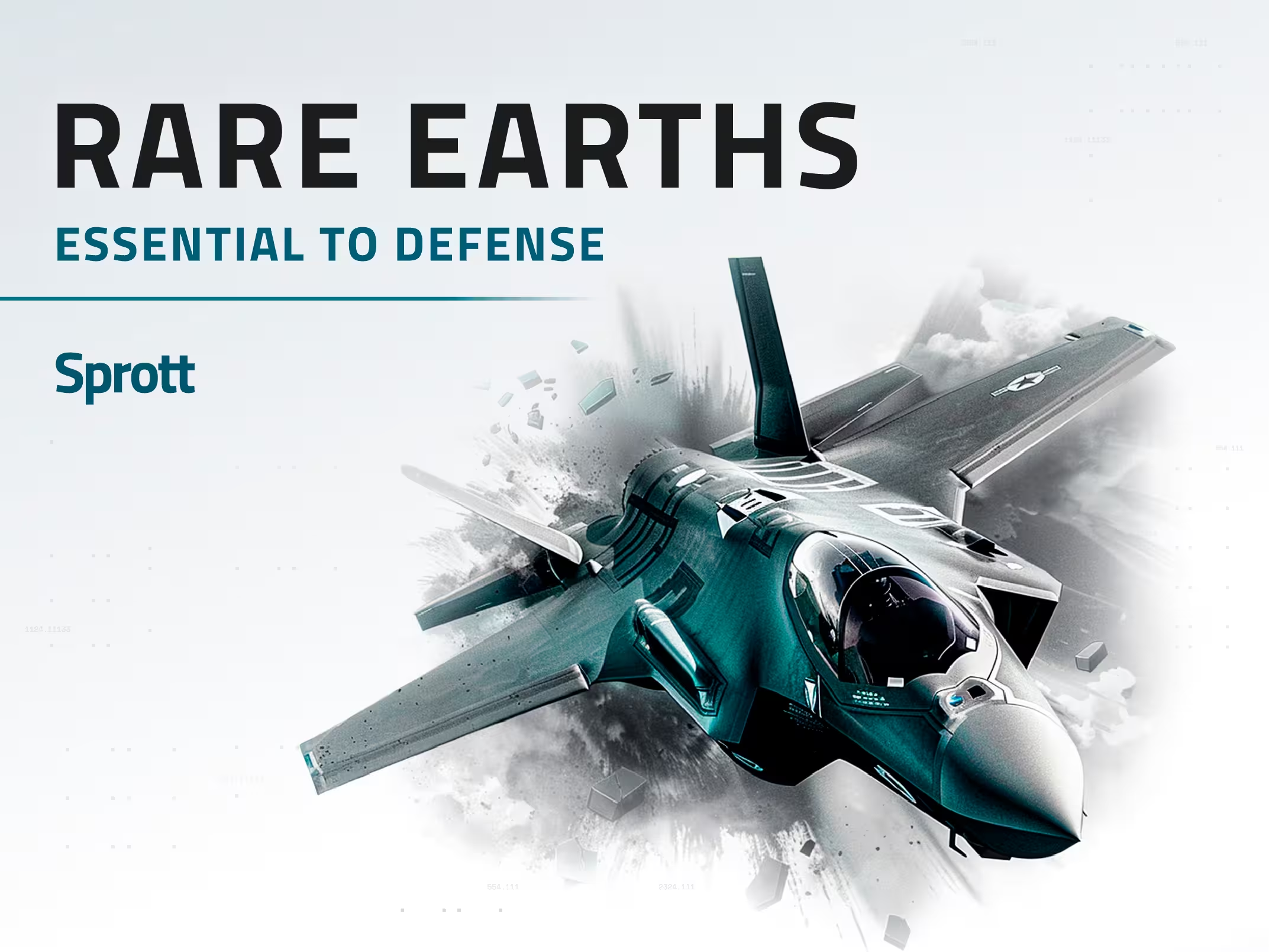
In September 2022, the Pentagon quietly stopped taking delivery of new F-35 fighter jets. The reason was not a design flaw or a manufacturing defect. A single small magnet inside the plane's engine had been made using an alloy from China, which is banned under U.S. defense procurement law.

One consumer-electronics company is now worth more than every publicly traded mining company on Earth combined. The graphic above captures the June 5 snapshot, when the 317 publicly traded miners tracked by CompaniesMarketCap were worth about $3.48 trillion