Critical Minerals
A Few Countries Control the World's Energy Transition Minerals
WHY BUILDING A NEW MINE WON'T BREAK CHINA'S GRIP
The following content is sponsored by Mining Forum Americas

When China restricted exports of seven heavy rare earth elements and their magnets on 4 April 2025, factories felt it within weeks. Carmakers in the United States, Europe and Japan reported disruptions serious enough to cut output or halt production lines, and Washington negotiated a 90-day truce to restart the flow. The episode exposed where the leverage really sits. The problem was not a shortage of ore in the ground. It was the refining and magnet-making capacity that turns ore into usable parts, a stage where alternatives barely exist. Opening a new mine, on its own, would not have kept those production lines running.
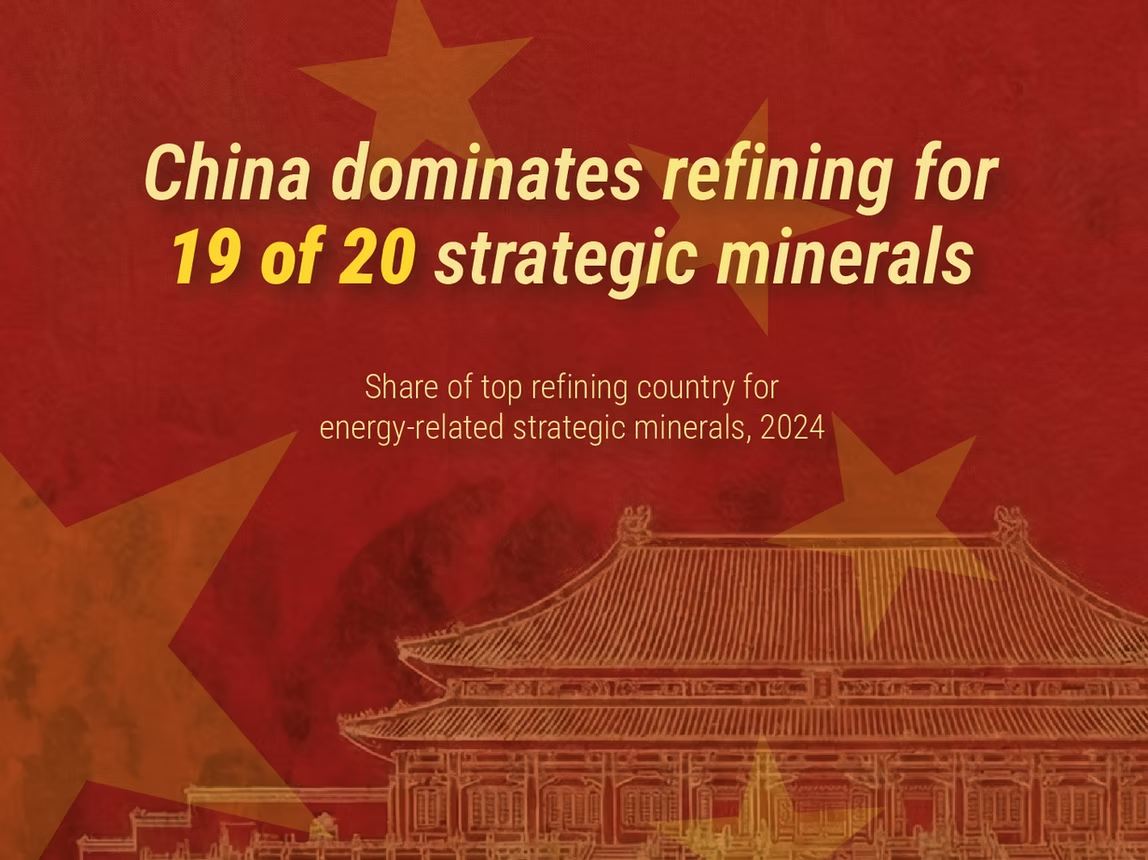
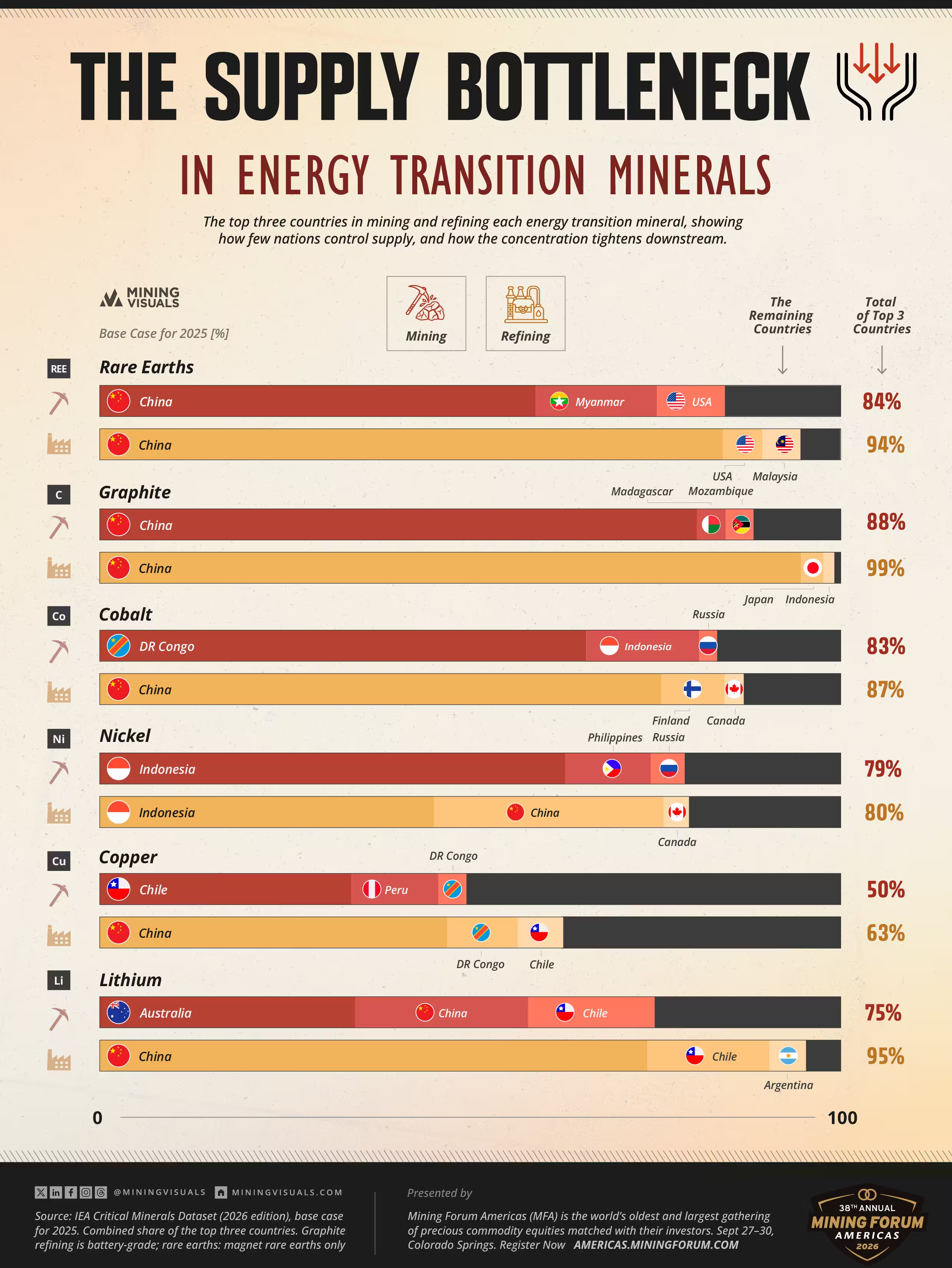
The mining and refining charts look similar at a glance, but the gap between them is the whole story. Mining leadership is genuinely spread: the Democratic Republic of the Congo leads cobalt, Indonesia leads nickel, and Australia leads lithium, according to the IEA. A company can open a rare earth mine in Australia or the United States and still find the ore has to travel to the same handful of refineries to become sellable. The IEA has been blunt on the point: China is the leading refiner for 19 of 20 strategic minerals, at an average share near 70%, and that concentration has intensified. Diversifying mines without building refineries simply relocates the first step and leaves the chokepoint intact.
Look at any mineral in the graphic above and the same thing happens twice: the refining bar is longer than the mining bar. That gap is the whole point. Ore can come out of the ground in a dozen countries, but it has to funnel through a far smaller set of refineries to become anything useful, and for most of these minerals that funnel runs through one country. The wider the gap between a mineral's two bars, the more a buyer's real dependence sits downstream, where it is hardest to see and hardest to replace. Nickel is the one exception worth noticing: Indonesia, not China, leads its refining, which is no accident. It is what a decade of deliberate processing investment looks like, and it is the clearest evidence that this concentration was built, not inherited from geology.
A mine used to be judged mostly on the price of the metal it produced. Now it is also judged on whether it helps a country depend less on China, and that is starting to move real money. The clearest example came in July 2025, when the U.S. Department of Defense invested $400 million in MP Materials, the only company mining rare earths in the United States. The deal made the Pentagon the company's biggest shareholder and locked in a ten-year commitment to buy its magnets. It was the first time the U.S. government had taken a major stake in a mining company of this kind, a sign that supply security, not just cost, is now driving where money goes.
For now, the worst of the pressure is on hold, but only on hold. In October 2025 China went further than before, extending its controls to products made outside the country if they contain Chinese material, and even to the equipment other nations would need to build their own refineries. It then paused that package until 10 November 2026. But a pause is not a fix: the refineries and magnet plants that give the controls their power are still there, and new plants elsewhere are years away from running at scale. The IEA has estimated that if the full controls came back, they could put around US$6.5 trillion of global economic activity a year at risk. Whether the rest of the world can build enough capacity before that deadline is the question now steering where mining money goes.

Mining Forum Americas 2026, presented by the Denver Gold Group, is the world's oldest and largest gathering of precious commodity equities matched with their investors. Held annually since 1989, it brings together roughly seven-eighths of the world's publicly traded gold and silver companies, measured by production or reserves, alongside the investors who follow them.Taking place September 27 to 30, 2026 at the Broadmoor Hotel & Resort in Colorado Springs, the Forum is built around three things: connecting investors and companies through one-on-one meetings, learning from industry leaders and analysts, and investing through direct access to senior and emerging producers.Learn more at americas.miningforum.com.
MiningVisuals Disclaimer: This article is for informational purposes only and does not constitute financial or investment advice. Always conduct your own research.


The U.S. Department of the Interior’s addition of silver to the Final 2025 List of Critical Minerals in November 2025 marks a pivotal shift. No longer viewed primarily as a precious metal for jewelry and investment, silver is now recognized as vital to technology, the energy transition, and national security.
As the European Union moves toward its goal of net-zero emissions by 2050, the demand for critical raw materials, the building blocks of wind turbines, batteries, and solar panels—is skyrocketing.