Copper
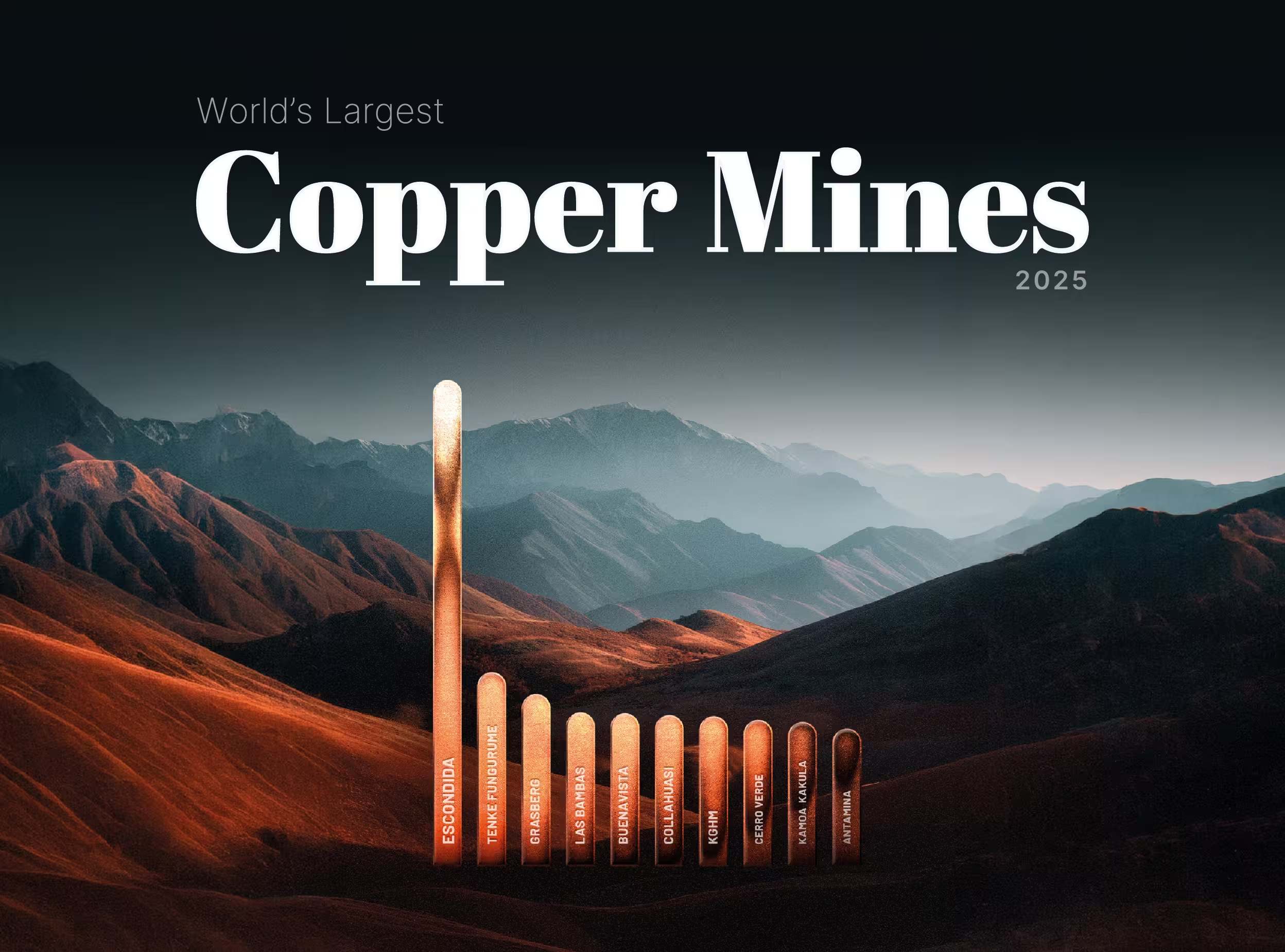
The World’s Largest Operating Copper Mines Alongside Reko Diq
Escondida produced 1.32 Mt in 2025. Reko Diq’s plan averages 460 kt a year from 2034 to 2043
This infographic was produced in partnership with the Pakistan Minerals Investment Forum 2026.


Six Countries, Five in South America: The ten largest operating copper mines in 2025 are spread across six countries, based on Wood Mackenzie estimates.
Grasberg at 67% After Mud Rush: Mill throughput averaged about 67% of pre-incident rates in Q3 2026, according to Freeport-McMoRan.
Reko Diq Planned Output: Barrick’s feasibility study plans an average of 460,000 tonnes of copper a year from 2034 to 2043.
Ten operating mines in six countries each produced between 359,000 and 1.32 million tonnes of copper in 2025, according to Wood Mackenzie estimates. Reko Diq in Pakistan appears alongside them with a figure from Barrick’s feasibility study, which refers to planned future production.
More than half of the ten mines’ combined output came from the five in South America. The 2025 figures also reflect a disrupted year at Grasberg in Indonesia, while Reko Diq’s number points to a project planned in two phases.
Chile’s two mines, Escondida and Collahuasi, produced about 1.75 million tonnes of copper combined in 2025, based on Wood Mackenzie estimates. Peru has three, Cerro Verde, Las Bambas and Antamina, with about 1.19 million tonnes between them. In the Democratic Republic of Congo, Tenke Fungurume and Kamoa-Kakula produced about 914,000 tonnes. The remaining three are Grasberg in Indonesia, Buenavista del Cobre in Mexico and Norilsk in Russia.
Grasberg’s 455,000 tonnes reflects a September 2025 mud rush at its Block Cave underground mine. Freeport-McMoRan had expected the Block Cave to supply about 70% of PT Freeport Indonesia’s forecast copper and gold production through 2029. Production resumed at the unaffected Deep Mill Level Zone and Big Gossan mines in late October 2025, and the Block Cave restarted in late March 2026.
In an October 2026 update, Freeport said third-quarter mill throughput averaged about 140,000 tonnes of ore per day, roughly 67% of pre-incident rates. The company expects to reach 80% of capacity in mid-2027 and approach full capacity by year-end 2027.
Reko Diq’s 460,000 tonnes is the average annual output Barrick’s feasibility study plans for 2034 to 2043, following a first phase of up to 240,000 tonnes a year, Mining Weekly reported. The study gives the mine a life of at least 37 years. Barrick owns 50% of the project. Three federal state-owned enterprises hold 25% and the Government of Balochistan holds 25%.
Learn More at PMIF 2026, Reko Diq is on the technical conference programme at the Pakistan Minerals Investment Forum, held in Islamabad on 12 and 13 November 2026.
MiningVisuals Disclaimer: This article is for informational purposes only and does not constitute financial or investment advice. Always conduct your own research.


In May 2025, a joint venture of Lundin Mining and BHP released a resource estimate for its Vicuña district in the Andes, which S&P Global ranked as home to the largest greenfield copper discovery in 30 years. Per the same resource statement, the combined Filo del Sol and Josemaria deposits hold 13 million tonnes of contained copper in measured and indicated resources.
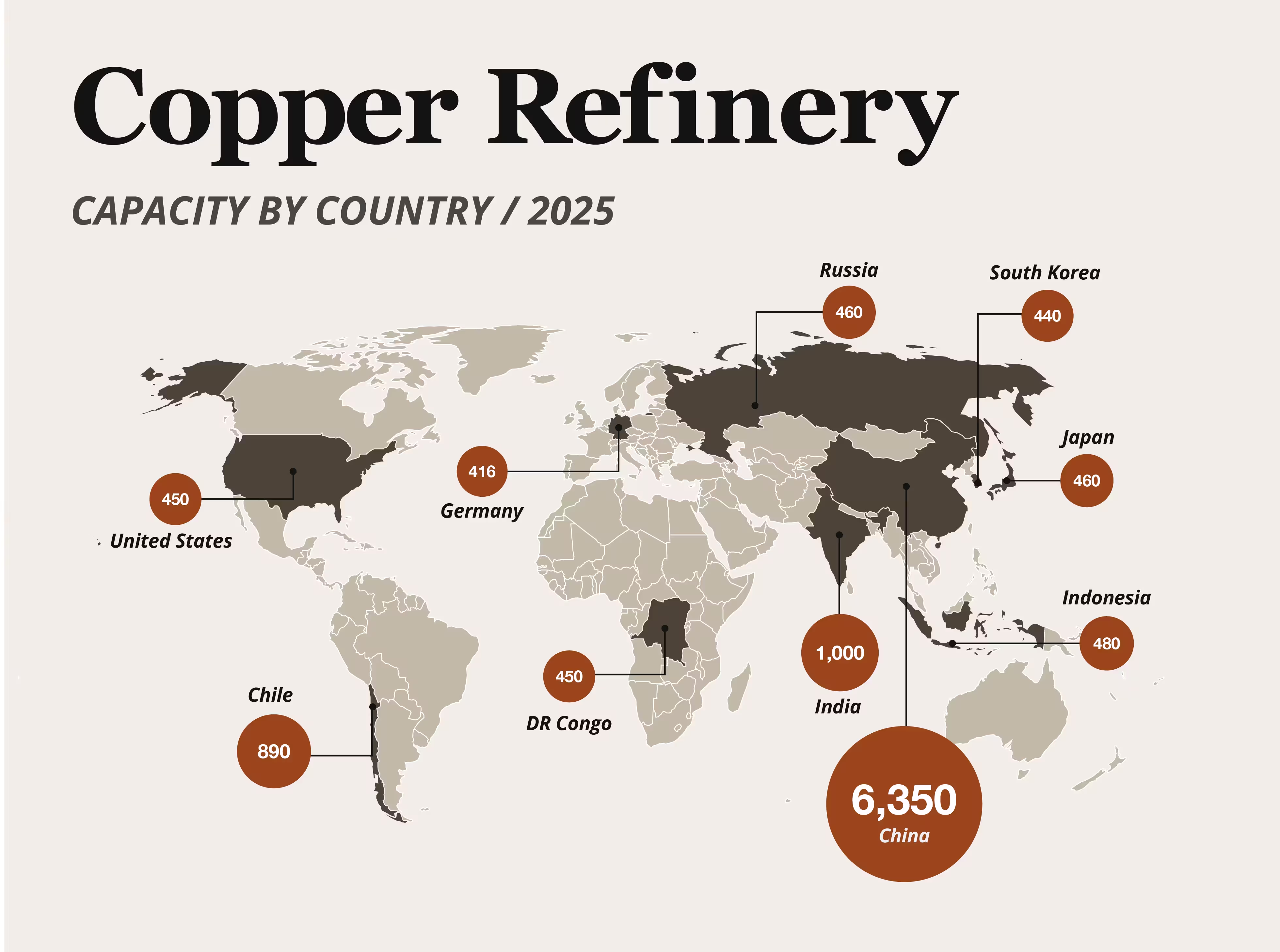
Indonesia's circle on the map above stands for a single plant: the Manyar refinery in East Java, operated by PT Freeport Indonesia, with 480,000 tonnes a year of capacity, according to the International Copper Study Group. It has been shut since the fourth quarter of 2025, after a mudflow at the Grasberg mine cut off its concentrate supply, and is due to restart this month at below 30% of capacity.
Copper has spent 2026 setting records, touching an intraday COMEX high of $6.71 per pound on May 13 amid AI-driven demand and supply shocks, against a backdrop where the ICSG now forecasts a 150,000-tonne deficit for 2026. In a market this tight, where the deficit thesis turns on lost tonnes, the question of where the world's copper actually comes from carries unusual weight.

Copper has spent most of 2026 doing something it had not done in a quarter century: setting fresh records every few weeks. The COMEX contract printed an intraday all-time high of $6.71 per pound on May 13, and the May monthly close looks set to land at the top of the historical chart. In London, copper traded above $14,000 per tonne in mid-May, touching $14,196.50, within reach of the LME's January 29 record of $14,527.50.