Copper
Most Major Copper Discoveries Since 1990 Are Still Not Mines.
OF 148 COPPER DISCOVERIES NOT YET IN PRODUCTION, ONLY 15 HAVE BROKEN GROUND
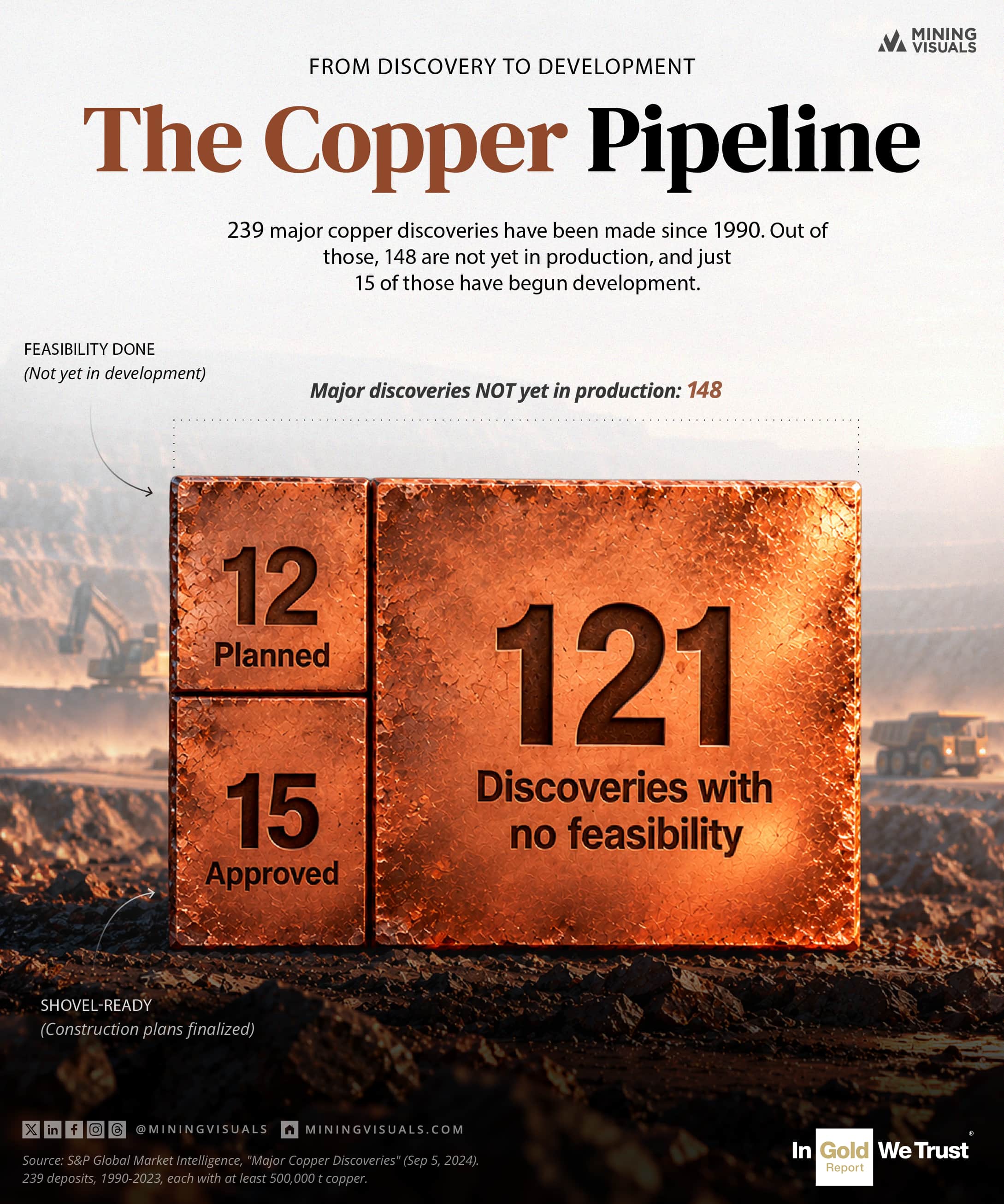

Four Finds in Five Years: Of 239 major copper discoveries since 1990, only four came from 2019 to 2023, together holding 4.2 million metric tons of copper.
148 Still Short of Production: 148 of the 239 are not yet in production, and 121 of those have not completed a feasibility study.
Growth Comes From Old Deposits: Only 14 of the 239 deposits were found in the past decade, with most reserve growth coming from expansion at 1990s-era finds rather than new discoveries.
In May 2025, a joint venture of Lundin Mining and BHP released a resource estimate for its Vicuña district in the Andes, which S&P Global ranked as home to the largest greenfield copper discovery in 30 years. Per the same resource statement, the combined Filo del Sol and Josemaria deposits hold 13 million tonnes of contained copper in measured and indicated resources.
That single discovery stands out because finds of its scale have become rare. It sits inside the same S&P list of 239 major deposits (data through 2023), most of which are not producing mines but earlier-stage projects still working toward development.
Most Discoveries Haven't Reached a Feasibility Study
Of the 239 major discoveries, 148 are not yet in production, and 121 of those have not completed a feasibility study. A feasibility study is the detailed engineering and economic assessment a deposit needs before construction can be financed, so the deposits without one are at the earliest point in the sequence from discovery to mine.
That leaves only a small group further along. After the 121 without feasibility studies, the remainder of the 148 have either completed that work or, in 15 cases, finalized construction plans and begun development.
The Industry Shifted Away From New Deposits
The slowdown in new finds tracks a shift in where companies spend. Grassroots' share of the copper exploration budget in the 1990s and early 2000s typically ranged between 50% and 60%, the share funding the generative exploration that finds entirely new orebodies. S&P attributes the dearth of recent discoveries to the industry's continued focus on brownfield assets, extending known deposits, rather than that generative work.
Veteran resource investor Rick Rule has described the same shift, pointing to decades of underinvestment across exploration and development.
The effect shows in where reserve growth comes from. In that year's update, 70% of the growth in discovered copper came from expansion at deposits first found in the 1990s, not from new finds, even as exploration budgets rose 12% in 2023.
What the 15 Represent
The 15 deposits that have begun development are the furthest along of the 148 not yet in production. S&P describes them as having finalized construction plans and begun development, the last stage a deposit passes through before it can count as a producing mine.
Even Vicuña, ranked the largest greenfield discovery of the past three decades, entered the S&P list as a discovery rather than a mine. It sits at the start of the same sequence the other 148 deposits are moving through, from feasibility study to construction to production.
The Picture Is Already Moving
Since this analysis, S&P Global has published its 2026 discoveries review, covering 1990 through 2025. It counts 263 major discoveries with 165 not yet in production, and records no deposit meeting its threshold found during 2025, extending the trend the figures above describe rather than reversing it.
MiningVisuals Disclaimer: This article is for informational purposes only and does not constitute financial or investment advice. Always conduct your own research.

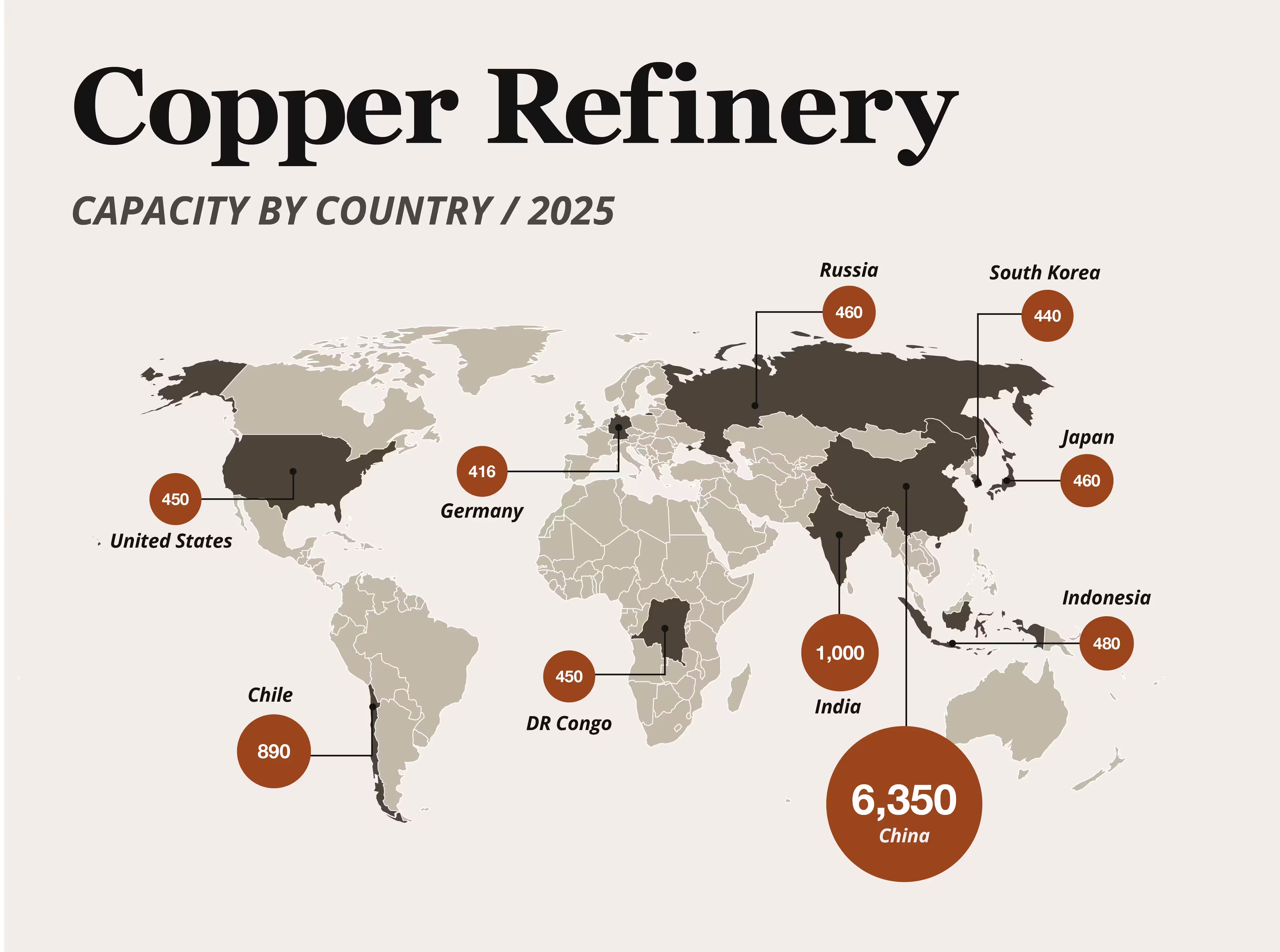
Indonesia's circle on the map above stands for a single plant: the Manyar refinery in East Java, operated by PT Freeport Indonesia, with 480,000 tonnes a year of capacity, according to the International Copper Study Group. It has been shut since the fourth quarter of 2025, after a mudflow at the Grasberg mine cut off its concentrate supply, and is due to restart this month at below 30% of capacity.
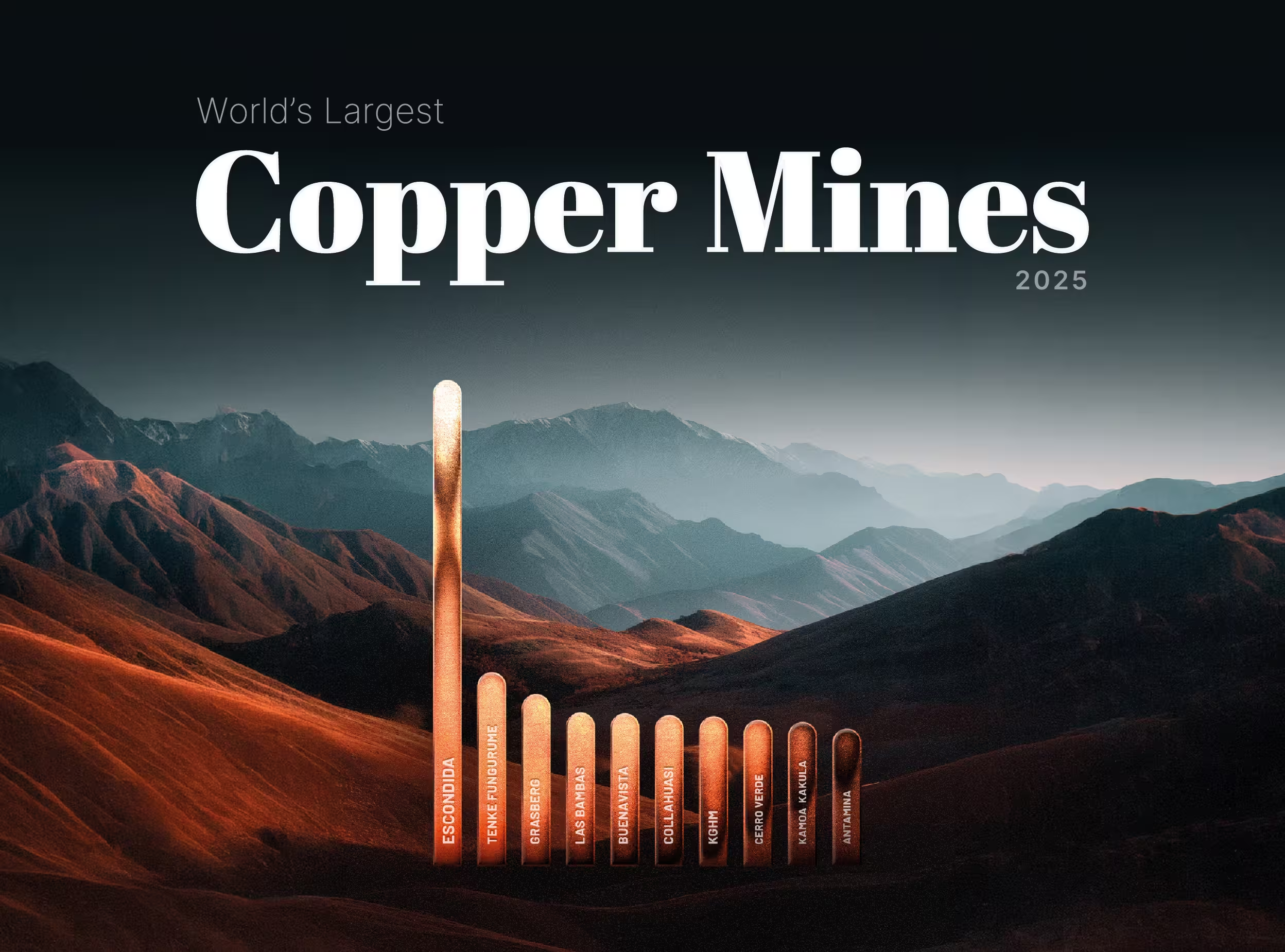
Copper has spent 2026 setting records, touching an intraday COMEX high of $6.71 per pound on May 13 amid AI-driven demand and supply shocks, against a backdrop where the ICSG now forecasts a 150,000-tonne deficit for 2026. In a market this tight, where the deficit thesis turns on lost tonnes, the question of where the world's copper actually comes from carries unusual weight.

Copper has spent most of 2026 doing something it had not done in a quarter century: setting fresh records every few weeks. The COMEX contract printed an intraday all-time high of $6.71 per pound on May 13, and the May monthly close looks set to land at the top of the historical chart. In London, copper traded above $14,000 per tonne in mid-May, touching $14,196.50, within reach of the LME's January 29 record of $14,527.50.

Copper futures touched an all-time high above $6.58 per pound on May 12, 2026, capping a 40.86% gain over the prior twelve months as supply tightness collided with structural demand from grid build-out, electric vehicles, and AI data centers. Earlier in the year, the LME benchmark rallied 22% to a record $13,387 per tonne on January 6, 2026. Behind the price action lies a less-discussed story: what it actually costs the world's largest miners to pull a pound of copper out of the ground.