Copper
January 23, 2025
2 min
Copper


Copper production in Africa has played a pivotal role in shaping the continent's economic and industrial landscape. From its modest beginnings in the early 20th century to becoming a global force in the copper market, the story of African copper is one of growth, challenges, and transformation.
Early 20th Century: The Foundation of African Copper Mining
The copper mining industry in Africa began in earnest during the early 1900s. The discovery of rich copper deposits in what is now Zambia and the Democratic Republic of Congo (DRC) drew significant attention. Mining activities in these regions were spearheaded by colonial powers and foreign companies, focused on meeting the industrial needs of Europe and North America. By the 1920s, the "Copperbelt," spanning Zambia and the DRC, became one of the world's most significant copper-producing regions.
The Rhodesia Railways, established in the late 19th century, played a critical role in linking southern Africa's mining hubs to global markets. Built to support the booming mining industry, particularly copper and gold, the railway network enabled efficient transportation of resources, fueling economic growth.
Mid-20th Century: Expansion and Nationalization
Copper production surged in the mid-20th century as global demand for the metal increased. The post-World War II economic boom, coupled with advancements in technology, drove the need for copper in construction, electrical wiring, and industrial applications. Zambia and the DRC became leading producers, with state-owned enterprises playing a prominent role after the wave of nationalizations in the 1960s and 1970s. However, political instability and underinvestment began to affect the efficiency and profitability of the sector.
Late 20th Century: Decline and Privatization
By the 1980s and 1990s, copper production in Africa faced significant challenges. Falling global copper prices, mismanagement of state-owned mines, and aging infrastructure led to declining output. The sector underwent major reforms, including privatization. In Zambia, for instance, the privatization of the Zambia Consolidated Copper Mines (ZCCM) in the late 1990s brought in foreign investment and revitalized the industry.
21st Century: Revival and Modernization
The early 2000s marked a resurgence in African copper production, driven by rising demand from emerging economies, particularly China. The DRC regained prominence as one of the world's top producers, with investments in new mining projects and technologies. Zambia continued to expand its production, and other nations, including Botswana, Namibia, and South Africa, emerged as notable contributors.
Present Day: Challenges and Opportunities
Today, Africa remains a critical player in global copper production. The DRC and Zambia collectively account for a substantial share of the world’s output. However, challenges such as infrastructure deficits, political instability, and environmental concerns persist. At the same time, the global shift toward renewable energy and electric vehicles offers immense opportunities for African copper producers to meet growing demand.
Source: https://ourworldindata.org/





Explore More
View All

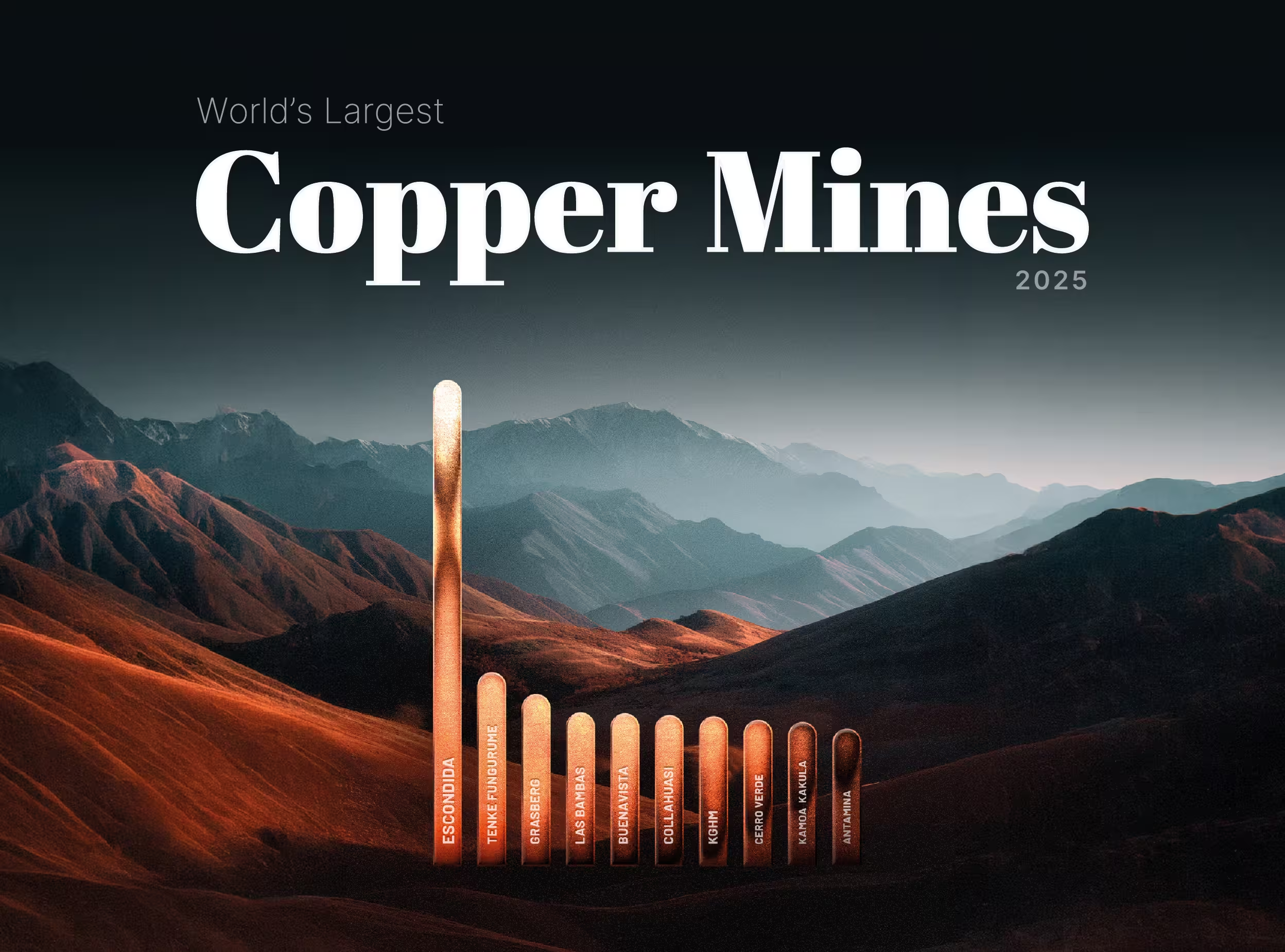
Ranked: The World's Largest Copper Mines (2025)
Ranked: The World's Largest Copper Mines (2025)
Copper has spent 2026 setting records, touching an intraday COMEX high of $6.71 per pound on May 13 amid AI-driven demand and supply shocks, against a backdrop where the ICSG now forecasts a 150,000-tonne deficit for 2026. In a market this tight, where the deficit thesis turns on lost tonnes, the question of where the world's copper actually comes from carries unusual weight.

Copper on Track for Its Highest Monthly Close on Record: A Look at the Drivers
Copper on Track for Its Highest Monthly Close on Record: A Look at the Drivers
Copper has spent most of 2026 doing something it had not done in a quarter century: setting fresh records every few weeks. The COMEX contract printed an intraday all-time high of $6.71 per pound on May 13, and the May monthly close looks set to land at the top of the historical chart. In London, copper traded above $14,000 per tonne in mid-May, touching $14,196.50, within reach of the LME's January 29 record of $14,527.50.

The Cost of Mining Copper: A 2024–2025 Update
The Cost of Mining Copper: A 2024–2025 Update
Copper futures touched an all-time high above $6.58 per pound on May 12, 2026, capping a 40.86% gain over the prior twelve months as supply tightness collided with structural demand from grid build-out, electric vehicles, and AI data centers. Earlier in the year, the LME benchmark rallied 22% to a record $13,387 per tonne on January 6, 2026. Behind the price action lies a less-discussed story: what it actually costs the world's largest miners to pull a pound of copper out of the ground.
Copper Production Q4 2025
Copper Production Q4 2025
As power-hungry AI data centers drive a projected 2-million-ton surge in global copper demand by 2030, market attention remains fixated on the supply side. Fourth-quarter 2025 metrics provide a definitive look at how the world's top miners closed out the year. While overall volumes remain heavily concentrated among a few historic industry giants, the true Q4 narratives emerged further down the list, as mid-tier producers leveraged flagship asset expansions to hit multi-year highs and offset the sector's ongoing struggle with declining ore grades.