Commodities
December 16, 2025
3 min
Commodities


Sweden has been a mining superpower for over a millennium, fueling everything from Viking expansion to the Great Power era. But as a century of data from the Swedish Geological Survey (SGU) reveals, the industrial footprint of this legacy has completely inverted.
The chart above tells the story of a radical transformation. While Sweden’s mining heritage was built on hundreds of small, labor-intensive sites—peaking at over 260 active metal mines during World War I—the modern reality is starkly different.
Today, the landscape that was once dotted with excavation pits has narrowed to just 12 operational sites (as of 2022). Yet, paradoxically, production has skyrocketed to record highs of over 87 million tonnes.
The industry has shifted from a game of quantity to one of massive scale. Here is why the numbers flipped:
1. The Geological Pressure: Declining Ore Grades
The most critical driver is geology. During Sweden's historical mining peaks (like the era of the famous Falu Gruva), miners could rely on rich, high-grade veins near the surface.
Over the last century, those "easy" deposits were exhausted. The average metal content per tonne of rock has naturally decreased, creating a volume imperative: to produce the same amount of refined metal today, mines must process significantly more raw ore than they did in 1920.
The blue production line had to rise exponentially simply to maintain supply, forcing the industry toward the only entities capable of handling such massive throughput.
2. The Technological Response: Scale as Survival
As the requirement for bulk tonnage increased, the viability of the small, historical mine evaporated. The "X" shape in the graph represents the moment mechanization replaced manual labor.
Around the 1950s and 60s, the introduction of heavy mechanization allowed for economies of scale that small mines could never achieve.
Today's 13 active mines—operated largely by leaders like LKAB and Boliden—are not just "mines" in the traditional sense; they are highly integrated industrial complexes. For example, Aitik (Boliden) is widely recognized as the world’s most efficient open-pit copper mine, utilizing extreme automation to profitably mine some of the lowest-grade copper ore on the planet. Similarly, Kiruna (LKAB) remains the world’s largest continuous underground iron ore mine, relying on driverless trains to maintain massive output at depth.
Active Metal Mines in Sweden:
3. Consolidation of Expertise
The sharp drop in the orange line represents a consolidation of expertise. The surviving mines represent the operations that successfully adapted to the "high volume, low cost" model.
According to the SGU’s Statistics of the Swedish Mining Industry 2022, this concentration has resulted in a robust system where fewer units are easier to regulate, safer to operate, and significantly more resilient to global price volatility than the fragmented industry of the past.
Conclusion
The "fewer mines, more ore" trend is not just about closing pits; it is about the optimization of a sector. Sweden’s mining history is a case study in maturity: evolving from the hundreds of small digs that built the nation's history into the few, massive giants that sustain its future.
Disclaimer: This article is based on data and information sourced from the Swedish Geological Survey (SGU), primarily the "Statistics of the Swedish Mining Industry 2022" report and related historical data presentations by SGU. While efforts have been made to accurately represent this information, readers are encouraged to consult the original SGU publications for comprehensive details. This article is for informational purposes only.



Explore More
View All

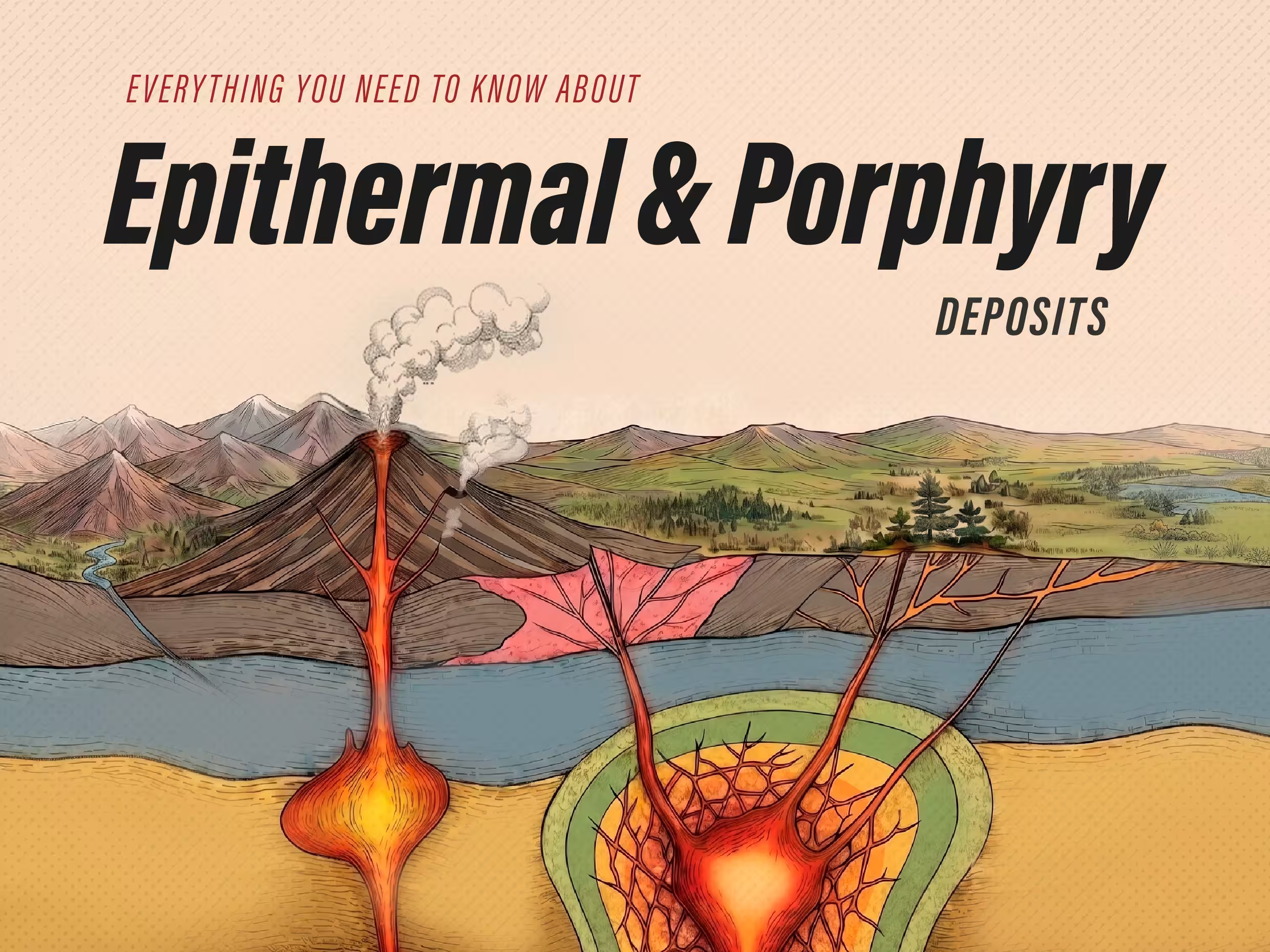
Inside Porphyry and Epithermal Deposits: The Geology of Earth's Most Productive Mines
Inside Porphyry and Epithermal Deposits: The Geology of Earth's Most Productive Mines
In March 2025, the USGS published an updated global database cataloguing every known porphyry copper deposit on Earth, a remarkable cartographic exercise for a deposit type that already supplies the planet with about 60% of its copper. What the database does not show is that the same magmatic engine produces a second, very different ore type immediately above: epithermal gold-silver veins

The Mohs Scale: Measuring Mineral Hardness from Talc to Diamond
The Mohs Scale: Measuring Mineral Hardness from Talc to Diamond
For over two centuries, diamond has sat unchallenged at the apex of mineral hardness. However, in early 2025, Chinese scientists successfully synthesized a hexagonal "super diamond" (lonsdaleite) that is theorized to withstand 58% more stress than standard cubic diamonds. While the frontier of material science pushes past natural limits, the foundational metric used to rank these materials remains surprisingly unchanged. Invented in 1812, the Mohs Scale of Mineral Hardness continues to be the ultimate benchmark for geologists, miners, and gemologists. Instead of complex chemical classifications, it relies on a simple, observable physical property: scratch resistance.

Properties of Common Minerals
Properties of Common Minerals
Minerals are the fundamental building blocks of rocks, forming the foundation of our planet and providing essential resources. From the humble Graphite in a pencil to sparkling Garnets in jewelry, minerals vary widely. But how do we tell these natural treasures apart?